Craft 4 min read
Off book without the dread
The off-book date is where many rehearsal processes stall. Taking the script away in stages, and learning cues as well as lines, makes it a step instead of a cliff.
Notes on teaching acting, drama and improvisation — rehearsal, the craft, the assessment, and the practicalities.
The off-book date is where many rehearsal processes stall. Taking the script away in stages, and learning cues as well as lines, makes it a step instead of a cliff.
How a line is asked for and given shapes how a cast feels about drying. A short protocol, agreed in advance, takes the embarrassment out of it.
A class show is a small production with a running order, time calls and a host. The practical parts — the order, the calls, the jam and the end time — decide whether the evening feels like theatre.
The most-quoted principle in improvisation is also the most misapplied. What it is actually describing, and how to build it without ever saying it.
A feature we will not build, and the reasoning — which is about what improvisation trains, not about data protection.
Rehearsal rooms have bad wifi. What that actually breaks, what it does not, and how to plan a lesson that does not depend on it.
Most drama warm-ups train something specific and are taught as though they train enthusiasm. What each of the common ones is actually for.
A thirteen-year-old and a seventeen-year-old in the same scene are not doing the same exercise. What actually differs, and how to cast around it.
Most improvised scenes die rather than end. Where the ending actually lives, and four ways to give a class one without taking the scene away from them.
Creating, Performing, Responding, Connecting. What each one means for a teacher planning an improvisation unit, and the one that usually gets skipped.
The assessment objectives are short, and the mark schemes built on them are not. What examiners are looking for in the devising component, in plain terms.
The KMK's three achievement levels were written for every subject, which makes them abstract in ours. What each one looks like in a practical drama lesson.
Notes that help you next Tuesday look nothing like notes that produce a grade. What to write down during a session, and what to leave out.
Most devising logs are written the night before and read like it. What the document is actually assessing, and what makes one worth reading.
Some things in an improvised scene are observable and defensible. Others are guesses wearing a mark scheme. Knowing which is which makes moderation survivable.
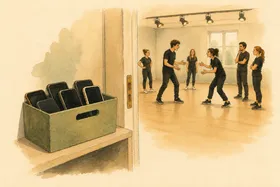
The argument for keeping them out is a good one. What changes when a phone stops being a distraction and becomes an instrument, and how to tell which you have.
Refusal in a drama room is usually about being watched, not about the exercise. Four things that help, and two that make it permanent.
What to do before you ask anyone to make something up in front of their classmates, and why the order matters more than the exercises.
Boal invented a role that is neither performer nor audience. It is also the most accurate description of what a drama teacher does during an exercise.
Spolin's central idea is that a student focused on a game acts naturally. The hard part is choosing the one thing, and resisting the urge to add a second.
A student who refuses an offer is telling you something about the exercise, not about themselves. What the refusal usually means, and what to change.
Students asked to 'play high status' produce a caricature. Students asked to change status halfway through produce a scene. The difference is where you put the instruction.
Spolin's most useful technique is also the hardest to deliver: a note to one player, mid-scene, that nobody else hears. What works in a room, and what does not.