
The devising log: what it is for
Most devising logs are written the night before and read like it. What the document is actually assessing, and what makes one worth reading.
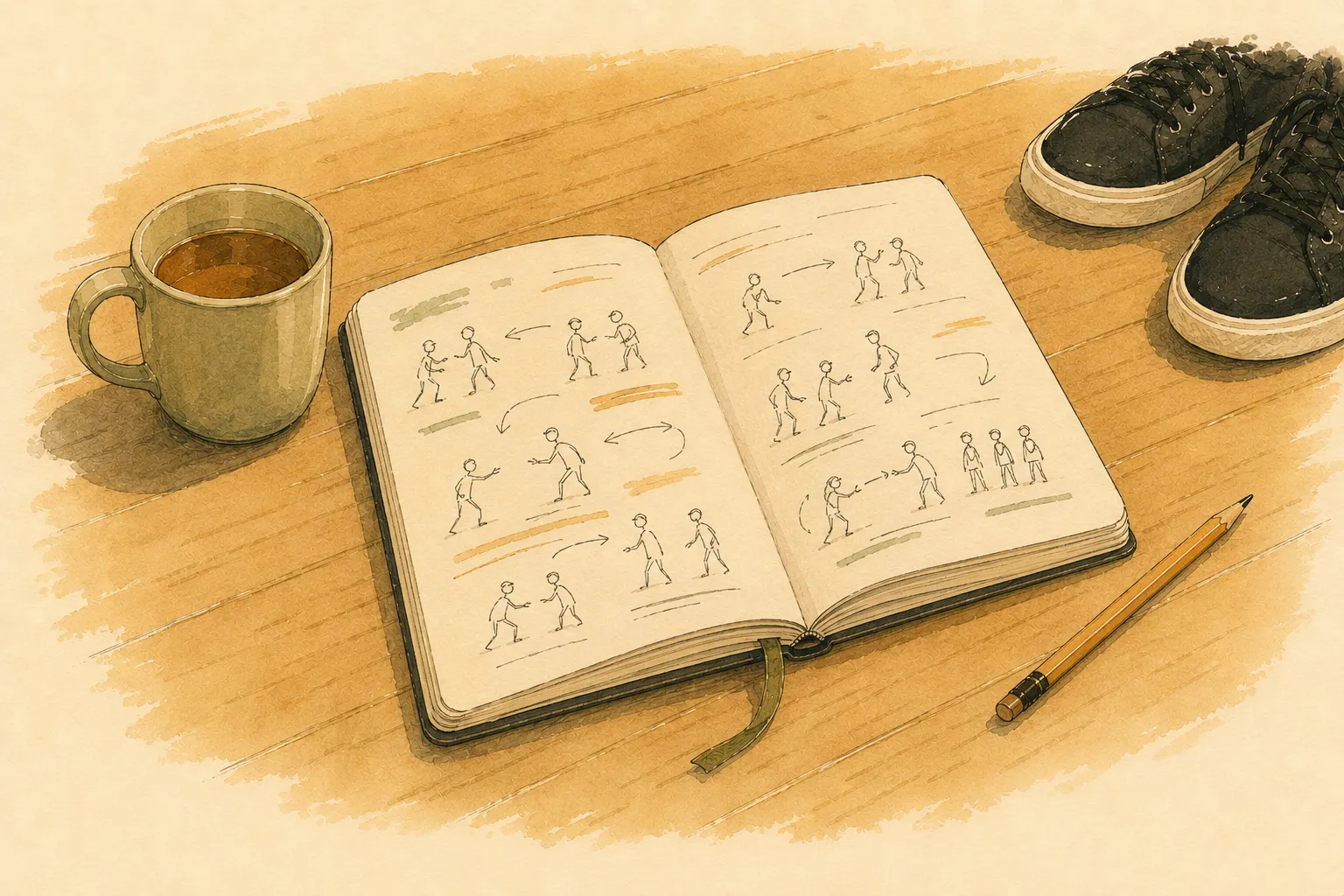
The devising log goes by different names — working notebook, process journal, portfolio — and in most specifications it carries real weight. In England it sits under AO1 and AO4: developing ideas, and analysing and evaluating the work.
It is also the piece of coursework most likely to be produced in one sitting, the night before, from memory. That version is not worth marking, and everyone involved knows it.
What the document is actually for
Not a diary. Not a record of what happened — the performance is the record of what happened. The log’s job is to make the thinking visible, which is the part a performance cannot show.
Three things in particular:
The decision, and the alternative it beat. “We decided she should leave” means nothing. “We tried her leaving and her staying; leaving made the last beat land harder because he was alone with it” is a decision with a reason and a comparison.
The thing that did not work. A log with no failures in it is a log written afterwards. This is the single most reliable tell, and it is worth telling students so directly — a section that says “this went wrong and here is what we changed” scores under AO4 in a way that a smooth narrative never will.
The change of mind. Evidence that the work developed rather than being executed. A student who thought the scene was about a job interview and then realised it was about the mother is showing the process; a student whose plan never moved is showing a plan.
What makes one readable
Dated entries, written the same day. Not because the date is evidence, but because a log written weekly is written from memory and reads like it.
Specifics with names in them. “We worked on status” is a topic. “I tried holding eye contact through Marek’s line and it made him rush” is an observation. The second is short, easier to write, and worth more.
Short. Three sentences after each session, fifteen times, is a better document than four pages once. It is also the only version students will actually produce, which matters more than any argument about quality.
The prompt that fixes most logs
Give them three questions, the same three every time, and nothing else:
What did we try? What happened? What are we doing differently next time?
Second-person plural in the first, past tense in the second, future in the third. It takes four minutes, it produces AO1 and AO4 material without either being mentioned, and it stops the log becoming an essay about feelings.
Where improvisation makes this easier
A devised piece has a long, blurry development where nothing is quite a decision. An improvisation exercise has a clean unit: one run, one constraint, one outcome. Students who find “describe your process” impossible can usually answer “what happened when you were told not to speak first”.
A log built from those is not less sophisticated. It is more honest, because each entry attaches to something that actually happened at a specific moment, and it is far easier for a moderator to believe.
What not to do with it
Do not mark it for writing quality beyond what the specification requires. A student with weaker literacy who is thinking clearly will lose marks for the wrong reason, and the log will teach them that the subject is really an English lesson.
Do not let it be retrospective. If a log can be written at the end, it will be. Collecting them mid-project — unmarked, just seen — changes what students write in a way that no amount of instruction does.
Questions
- How often should students write in it?
- After every session, in under five minutes, or they will not. A log with fifteen honest entries of three sentences is worth more than one written in a weekend, and the difference is visible to anyone who has read a few.
- Can it be a recording rather than writing?
- Check the specification — some boards permit it and some do not. Where it is allowed, a spoken log is often more honest, because students edit themselves less. The evidence requirement is usually about the thinking, not the medium.