
For schools
Every student's part on their own card — the school production in rehearsal, the set text, the devised scene.
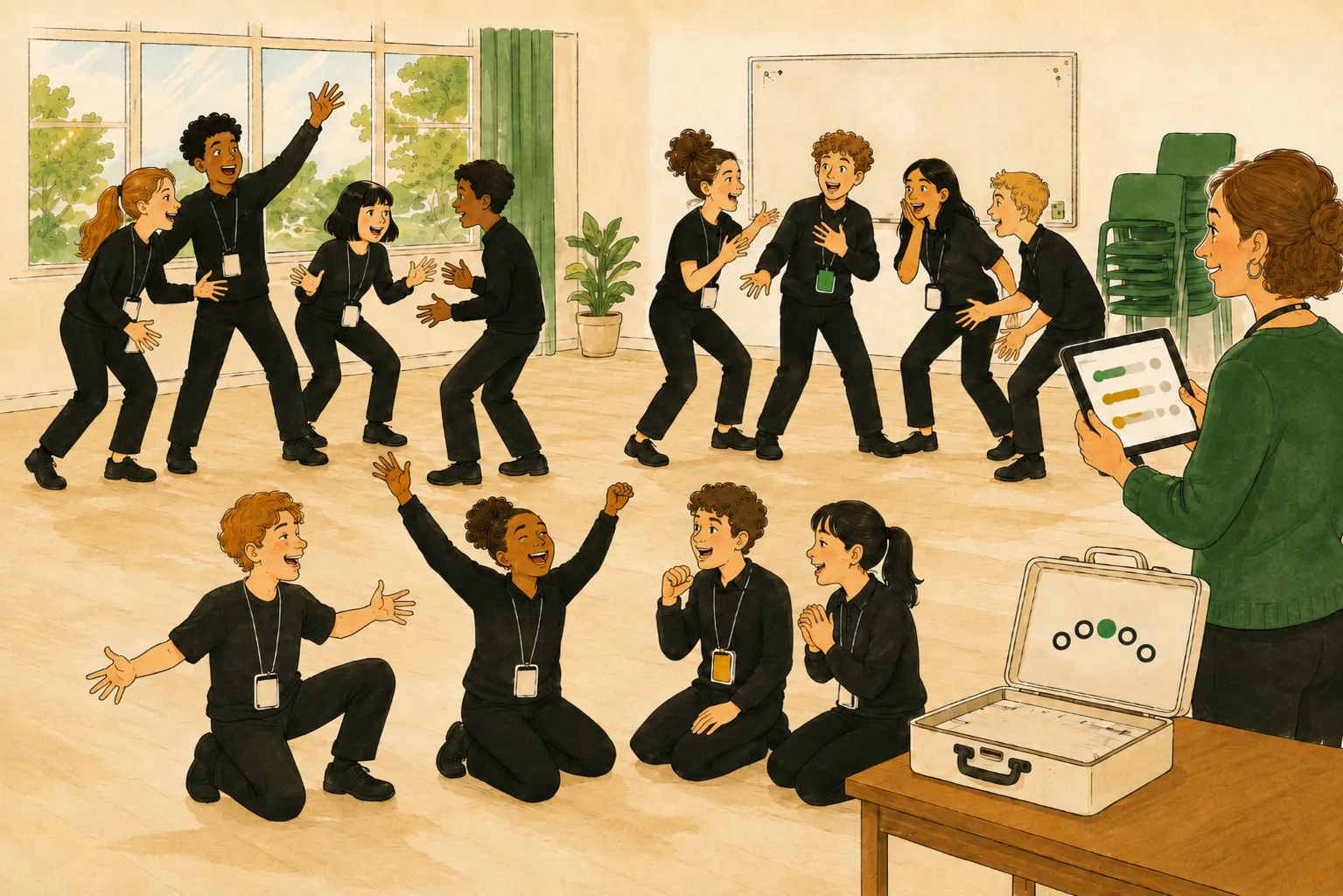
Drama is the one subject where so much happens in front of everyone. A class set of cards changes one part of that: the scene lives on your iPad, every student holds a card, and each student's line — under the cue that comes before it — reaches only their own pocket-sized screen, at the moment it is theirs. When a line goes, the prompt arrives on that card alone, and nobody calls it across the hall.
Data protection
The questions that decide a school purchase, answered first.
Do students have accounts?
No — and not "no email address", but no account of any kind. A student holds a card, a device the school owns. There is nothing for a student to sign in to, so there are no credentials to issue, reset, forget or leak. What the system holds about a student is a name and a group, a parental-consent record where one is needed, which card they were given, lesson records and any scores the teacher chose to give. No username, email or birth date.
Where is the data?
Stored in Frankfurt, in Google Cloud's europe-west3
region. The subprocessors, and what each one receives, are listed on
the subprocessor page.
What is kept, and for how long?
Session records — who was there, who played which role, any scores, what the teacher noted — are visible to the teaching teacher only. Deleted after twelve months by default; your school can set it as low as thirty days. Usage figures contain no student: no name, no identifier, no per-student row.
Is there advertising, profiling, or automated assessment?
No, no, and no. Nothing profiles a student, and no lesson record ever reaches an AI model — the AI in Composer works on scene text and a short brief. One exception to name: when a class-list import cannot tell what a column is, its headers and up to five sample rows can be sent to the model to work it out, and you check the result before anything is created.
What is a card, from your DPO's point of view?
A screen with no camera, no location, no storage of personal data, and no identity. The hardware has a microphone; Spontar's firmware never uses it. It is registered to the school, never to a child, and which student holds it is decided fresh by the teacher each lesson. There is no recording of any kind at any point.
We have a phone ban. Does this break it?
A card is not a phone. It belongs to the school, stays in the drama room's case, and does one thing: it shows a student their part. No camera, no apps, no messages, no browser, nothing to sign in to. Most phone policies are written about pupils' own phones, and a class set of school-owned devices usually sits alongside them the way the lighting desk does. Whether yours does is your school's decision; we will describe the device in writing for whoever makes it.
A processing agreement under Art. 28 GDPR, a record of processing, a subprocessor list and a privacy notice written for students rather than for lawyers — published, not requested. For pupils under sixteen (under thirteen in the US), parental consent is recorded before a session can start, and we never contact a family: the school holds that relationship and should keep it.
The lesson
Built for a class, not a club.
The school production, in rehearsal
Import the script — a PDF with a text layer, a Word file or pasted text — and each student's card shows the cue and their own next line: in full, as first letters, or not at all, set per student and changed as they learn it. When someone dries you tap their name and the words appear on their card alone. Afterwards you can see who dried on which line.
Devised and improvised work
A situation and a feeling for each role, revealed only to its player, or prompts you type on the iPad as the scene goes. Pictures work for younger students and for students who find reading hard. With no scene at all, the iPad can run the turns: who goes up next, with whom, and for how long.
Everyone gets up
A scene casts two to eight players, and the cast changes between scenes. The suggested cast prefers the students who have not played yet in this lesson; in a lesson run without a scene, the iPad proposes the next pair or group from who has been up least and who has worked together least. The quiet half of the class is not left to the confident three.
Assessment you can defend
Who was there, who played what and, in a rehearsal, where the lines went — recorded as it happens, with your own note on the lesson and any scores you chose to give beside it. When you write the devising-log commentary or the practical grade three weeks later, the evidence is already there.
Fits the timetable
Handing out cards happens alongside the register you already take. A library scene is estimated at eight to twenty minutes, so there is room for the debrief inside the hour.
Works in the hall, too
The kit's router makes the room its own network while the scene runs — no mDNS exception, no client-isolation ticket. The iPad needs a connection only to open the lesson and, afterwards, to upload the record. If your network team wants the detail anyway, we will write it up for them in whatever depth they ask.
Curriculum
Where this work already sits
Nothing here is a new pedagogy. Rehearsing a text, devising from a stimulus and structured improvisation with a teacher directing attention are old, well documented, and already sit inside the frameworks you work to.
England — GCSE and A-level drama
The devising component is assessed on creating and developing ideas (AO1) and on analysing and evaluating your own work and that of others (AO4), with the performance itself under AO2. A structured improvisation produces exactly the material a devising log is supposed to document: what was tried, in what order, and what changed as a result. The set-text and scripted components are rehearsal work, and lines on a card in place of a script in hand is one way to get a cast off the page sooner.
Spontar records what actually ran — which scene, which cast, how far it got, and your own note. Whether that is useful evidence is your judgement; the record exists either way, and the specification and mark scheme are your board's, not ours.
Germany — Darstellendes Spiel
The KMK's Einheitliche Prüfungsanforderungen for Darstellendes Spiel (2006) organise assessment across three Anforderungsbereiche: reproduction, reorganisation and transfer, and reflection and evaluation. Improvisation under a constraint sits squarely in the second, and the debrief that follows it in the third; working a scripted scene moves between the first and the second.
Most schools split Leistungsbewertung in DS between practical work and written reflection. Spontar touches the first only, and only as a record of what happened. It grades nobody by itself — any score is one you chose to enter, and your Bewertungsraster is yours, and the relevant Bildungsplan is your state's.
United States — National Core Arts Standards
The theatre standards are organised around four artistic processes: Creating, Performing, Responding and Connecting. A structured improvisation is a Creating activity that ends in a Performing one, rehearsing a scripted scene is Performing, and the debrief is Responding. The anchor standards your district uses are the ones to map against; the shape of the work fits them without being bent.
We do not claim alignment with any specification, and no board or ministry has reviewed this product. What we can say precisely is what it records and what it does not.
Who we are writing to
Independent schools first — for a practical reason.
An independent school can decide this itself: the head of drama and the bursar, a demo and a quote, without a procurement framework or a six-month cycle. State schools are welcome — the sequencing is about who can move, not who matters.
Bring your data protection officer. We mean it.
The demo is better with the sceptic in the room — most of this product was designed for their questions.
Talk to us