
Phones in the drama room
The argument for keeping them out is a good one. What changes when a phone stops being a distraction and becomes an instrument, and how to tell which you have.
Updated 3 October 2026
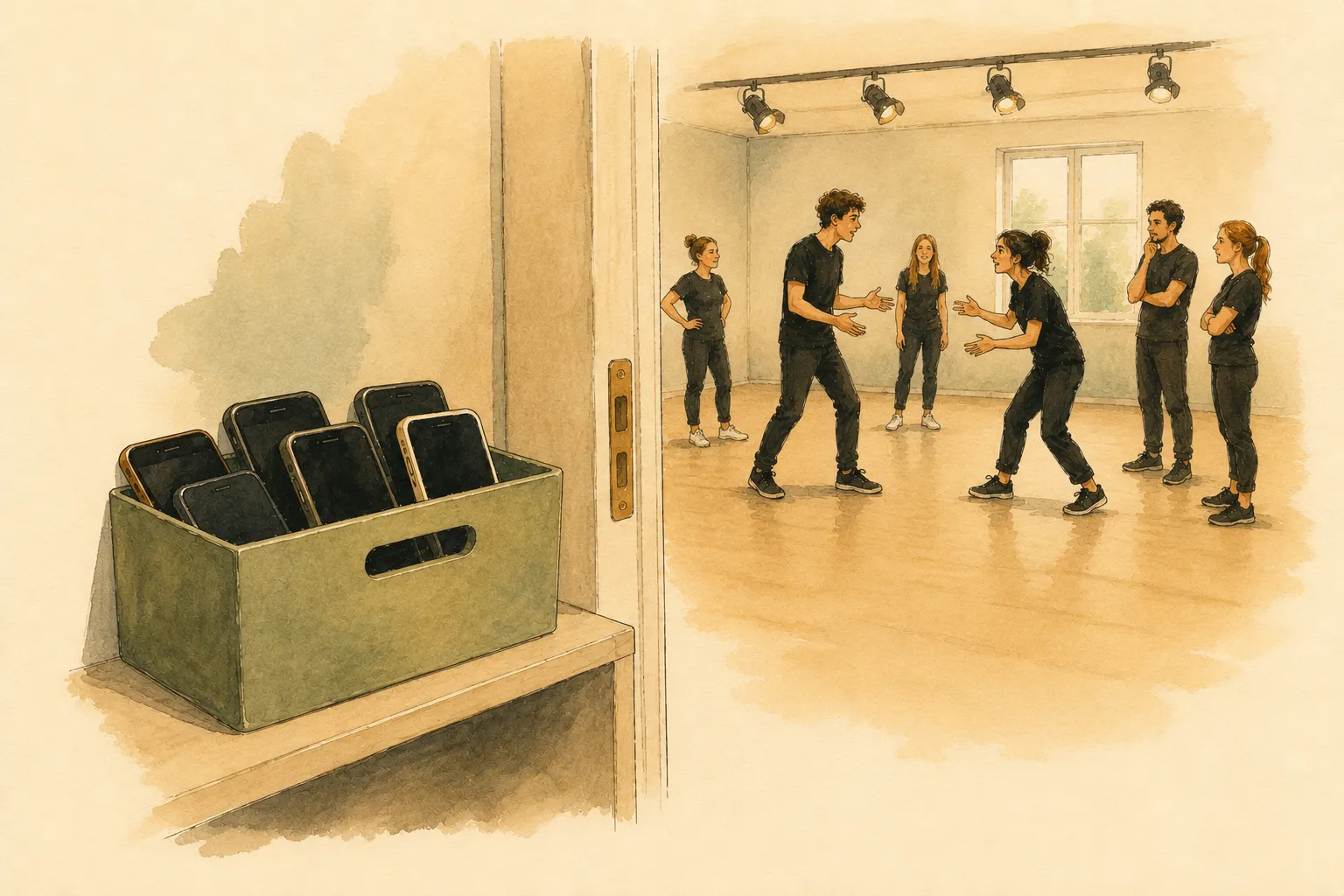
Most drama teachers have a phone policy, and most of them are some version of not in here. It is a defensible position and, for most of what happens in a drama room, the right one.
It is worth being precise about what the policy is protecting, because the answer determines whether it applies to every possible use.
What the ban is actually for
Attention. A student reading a message is not in the room. The whole subject depends on people watching each other, and a device that competes for that is working directly against the thing being taught.
Recording. A phone in a rehearsal is a camera, and a rehearsal is where people are bad at things in front of each other. A single clip circulating ends a group’s willingness to risk anything, permanently and immediately.
Status. Phones are social objects. Who is on one, who is being shown something, who is not — the drama room is one of the few places in a school where that hierarchy can be set aside for an hour, and phones bring it back in.
All three are real. None of them is about the hardware.
When a screen is an instrument
The comparison worth making is a script. Nobody argues that a script in a rehearsal is a distraction, even though it is a thing in your hand that you look at instead of at the other person. It earns its place because what is on it is the work.
A screen can pass the same test, and the criterion is specific:
One thing, briefly, that you cannot read ahead in. A cue that says she has already decided; you do not know yet and disappears is closer to a side-coaching note than to a script. A screen showing the whole scene is a script, and a worse one than paper because it glows.
No notifications. Anything that can interrupt fails the test regardless of what else it does. In practice this means aeroplane mode, a school device, or an app that genuinely takes over the screen.
No camera in use, ever, without an explicit and separate decision. The recording problem does not become smaller because the device is being used for something else.
The conversation with a class
Worth having once, out loud, and it takes ninety seconds:
“Phones are out for this, and here is why: nobody records anything in here, ever. If you’re using one for the exercise it is in aeroplane mode and it shows one line at a time. If it buzzes, it goes in the bag.”
Two things make that work. The reason is about the group rather than about compliance, and the rule is the same for everyone including you. A teacher whose phone is face-up on the desk has lost the argument before making it.
What actually changes in the room
Less than people expect, in both directions.
It does not fix the students who are not paying attention. A student who is disengaged with a phone is disengaged without one, and the phone is the symptom.
What it does change is what can be asked of a group at the same moment. An instruction — prepared beforehand or typed in the moment — that reaches one person at the moment it matters does not have to be announced to everybody else, which is the constraint that handing one player a secret has always had. In a scripted scene the same goes for a line: an actor who sees only their next line, just before their cue, is not reading ahead in the script. Whether that is worth a screen in the room is a judgement about your group, and it is genuinely a judgement — the honest answer for some groups is no.
The version worth trying first
Before any of this, try the low-technology version: index cards, handed out face-down, turned over when you say. It is clumsy, it does not scale past a handful of beats, and it will tell you within one lesson whether private cues change anything for your group.
If they do not, no device is going to help. If they do, you have learned something worth more than any tool.
Questions
- What about schools with a total phone ban?
- Then this is a conversation with a head teacher, not a workaround. A shared set of devices kept in the drama room can sidestep the policy entirely — the policy is usually about pupils' own phones and social media, not about a device that does one thing.
- Does the screen not pull attention away from the room?
- It does whenever it has anything on it. That is why what is on it matters far more than whether it is there: a screen showing a whole score is a script, and a screen showing one line for eight seconds is a cue.