
The four artistic processes, and where improvisation sits
Creating, Performing, Responding, Connecting. What each one means for a teacher planning an improvisation unit, and the one that usually gets skipped.
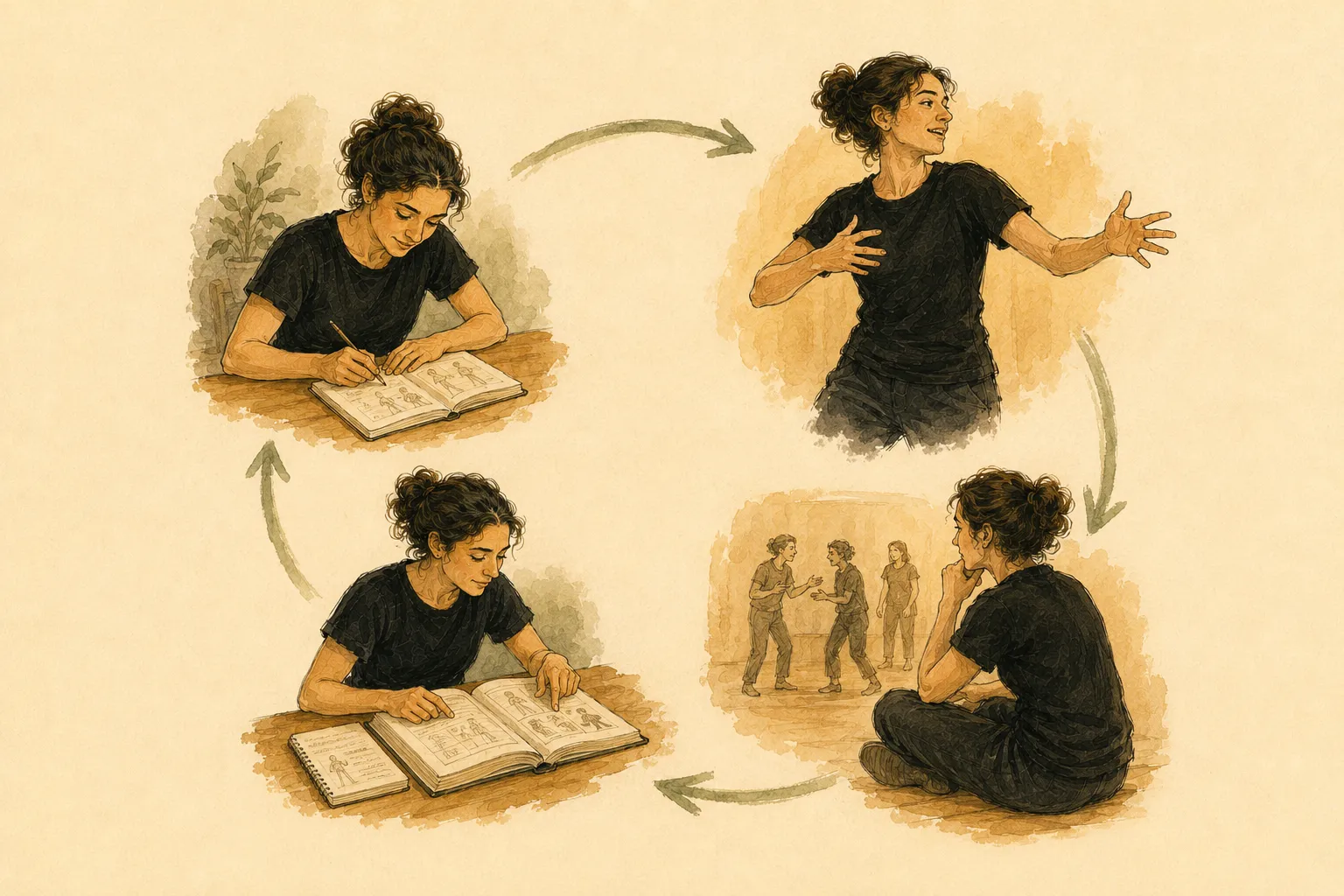
The National Core Arts Standards organise theatre around four artistic processes: Creating, Performing, Responding and Connecting. They are deliberately verbs, and the choice matters — the standards describe what students do rather than what they know.
For anyone planning improvisation work, three of the four are obvious and the fourth is the one that quietly disappears.
Creating
Generating and conceptualising, organising and developing, refining and completing.
Improvisation is a Creating activity before it is anything else, and the standards are unusually well suited to it because they treat generation and refinement as separate steps. A student who improvises freely is generating; a student who runs the same scene three times with a tighter constraint each time is refining. Both are Creating, and a unit that only ever does the first is producing material and calling it a process.
The practical implication: run the same scenario more than once. It is the cheapest way to move a unit from generating into refining, and most improvisation teaching skips it because repetition feels like the opposite of improvising.
Performing
Selecting, preparing, sharing.
The awkward one for improvisation, because a genuinely improvised scene is not prepared. What the standards want here is a decision about what gets shared and in what form — which is a real decision in an improvisation unit, and one worth making explicitly.
A group that improvises fifteen scenes and shows the best three has selected. A group that improvises fifteen and shows them all has not, and has also spent most of the lesson as an audience.
Responding
Perceiving and analysing, interpreting, evaluating.
The debrief, and the strongest fit of the four. An improvisation exercise produces an immediate, shared, unrehearsed thing for a room to respond to, and nobody is defending a piece they spent six weeks on — which makes honest response far easier than it is after a devised performance.
Worth protecting the time for it. A unit that runs exercises until the bell and debriefs next week has moved Responding into a discussion about a memory.
Connecting
Relating artistic ideas to personal meaning and to external context.
This is the one that disappears, and it disappears because it is the least naturally produced by the activity. An improvisation lesson generates Creating, Performing and Responding whether or not you plan for them. It generates Connecting only if you ask.
Two questions do most of the work:
Where have you seen this happen outside a drama room?
Who wrote the rule we just used, and what were they trying to fix?
The second is worth more than it looks. Telling a class that the exercise they just did comes from a woman teaching immigrant children in 1930s Chicago, or from a man who invented a competitive format in Calgary in 1977, connects the work to a history the students are now part of. It takes ninety seconds and it is the difference between doing a technique and knowing where it came from.
Planning against the four
The useful check is not “does this lesson cover all four” — it should not — but “does this unit”. A unit that is heavy on Creating and Performing and thin on Responding is the common shape, and the fix is usually to run fewer scenes and talk about them properly.
If Connecting is missing entirely, that is the one to add, because it is the one that will not appear on its own.
Questions
- Are the anchor standards the same in every state?
- The National Core Arts Standards are voluntary and adopted or adapted state by state. The four artistic processes are stable across adaptations; the numbering and the performance indicators are what varies, so check your district's version for anything you will be held to.
- Does one lesson have to cover all four?
- No, and trying produces a lesson that does none of them. A unit covers four; a lesson usually covers one properly and touches a second.