
What you can honestly assess in an improvisation
Some things in an improvised scene are observable and defensible. Others are guesses wearing a mark scheme. Knowing which is which makes moderation survivable.
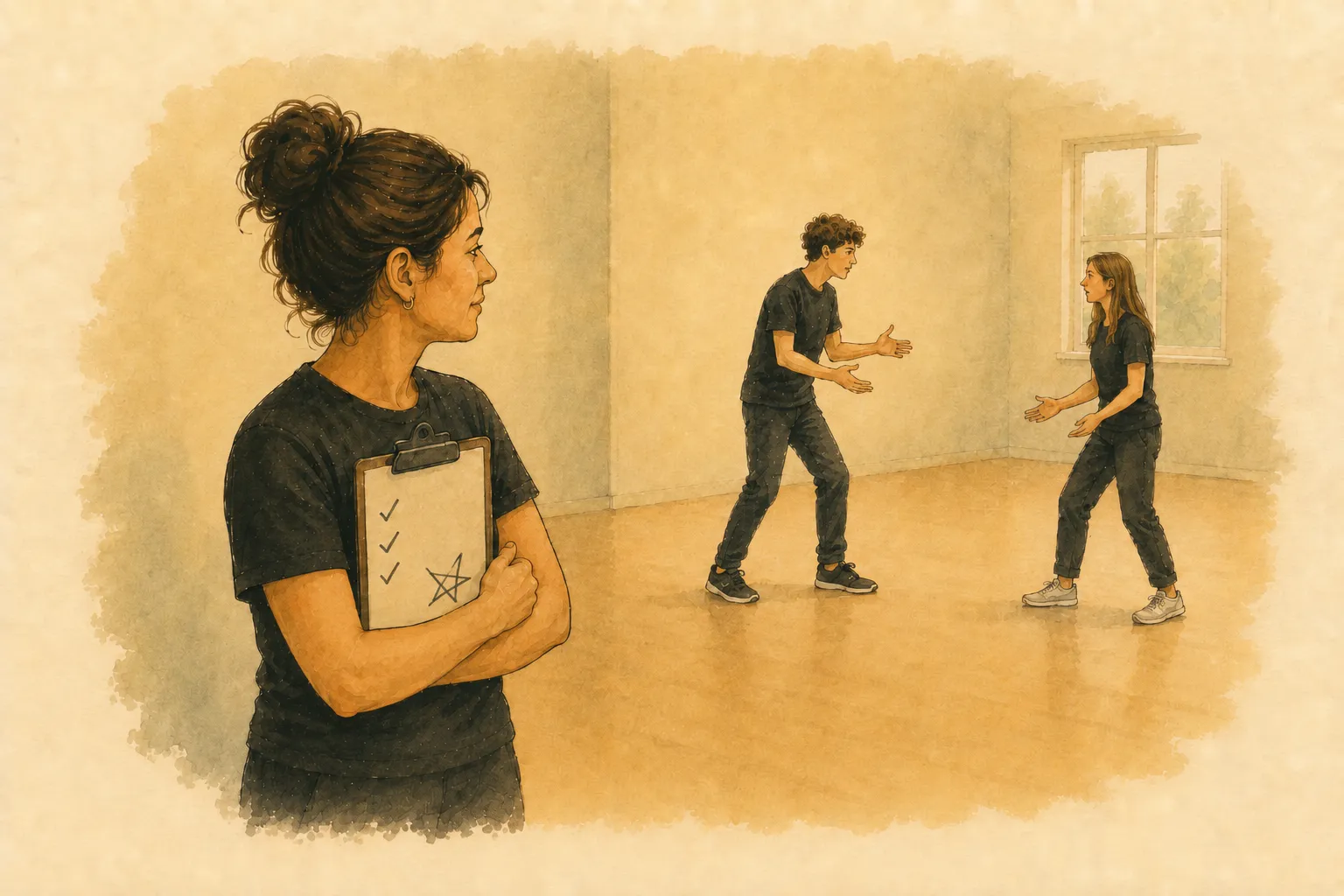
Assessment in practical drama is difficult for a specific reason: the thing in front of you is a group product, and the mark goes to an individual. In improvisation that problem is at its sharpest, because nothing was rehearsed and the student’s material depended entirely on what somebody else gave them.
That does not make it unassessable. It makes some things assessable and some things not, and the distinction is worth being strict about.
Things you can observe
Whether an offer was accepted. Binary, visible, and independent of quality. A student who takes “you’ve been waiting a long time” and builds on it has done something you can point at in a recording or describe to a moderator.
Whether the constraint was held. If the exercise said never speak first and the student never spoke first, that is a fact. Whether the scene was good is a separate question and one you do not have to answer.
Whether an adjustment happened. A status change, a shift in energy, a response to something a partner did — legible to a room or not legible. This is the assessable core of most improvisation work, and it survives moderation because two people watching can usually agree on whether they saw it.
Whether they did what they said they would. The devising-log question. A student who planned a tactic and then used it has demonstrated something independent of whether the tactic worked.
Things you cannot
Creativity. Not observable, not comparable, not defensible. A mark scheme that says “highly creative” is asking a teacher to rank imaginations, and the result correlates with confidence rather than ability.
Commitment. Reads as an assessment of personality, and it punishes the student who is anxious rather than the one who is disengaged. Both look the same from the front of the room and are entirely different problems.
How good the scene was. The most tempting one. A student in a scene that went well because their partner was inventive has not done more than a student in a scene that died. Assessing the scene assesses the casting.
Presence. Usually a description of a student who is tall and comfortable in their body, and it turns up in mark schemes far more than it should.
What this means for the mark scheme
The version that survives moderation is behavioural and boring:
Accepted and developed at least one offer from another performer. Held the given constraint for the duration. Made at least one visible adjustment in response to a partner. Can describe, afterwards, what they were trying to do.
Four things, all observable, none dependent on the scene being good. A student in a scene that fell apart can score full marks on all four, which is exactly right — the scene falling apart was not theirs alone.
The record that makes it possible
None of this works from memory. Watching fifteen students in six scenes and writing it up afterwards produces an assessment of who you remember, which correlates with who was loud.
What works is a note per student per scene, taken during or immediately after, in a form short enough to write without looking away. Three words is enough: took the offer. Held it. Adjusted on her.
It is not a rich record, and it is a defensible one. In a moderation meeting six weeks later it will be the only thing you have that is not a reconstruction.
The thing worth saying to the class
That you are assessing the work rather than the talent. Say it out loud, early, and mean it — a class that believes it is being ranked on whether it is funny will spend the term being funny, which is the wrong skill and a miserable way to learn anything.
Questions
- Is it fair to assess improvisation at all?
- Yes, if you assess what was done rather than what was produced. A scene's quality depends on who else was in it; a student's use of a technique does not. The second is assessable and the first is a lottery you are asking a teenager to win.
- How do you moderate this with a colleague?
- By agreeing the observable behaviours before watching, not the grades afterwards. Two teachers who have agreed what 'accepted the offer' looks like will agree on most students; two who have agreed only on a grade descriptor will not.