
One thing to hold: the point of concentration
Spolin's central idea is that a student focused on a game acts naturally. The hard part is choosing the one thing, and resisting the urge to add a second.
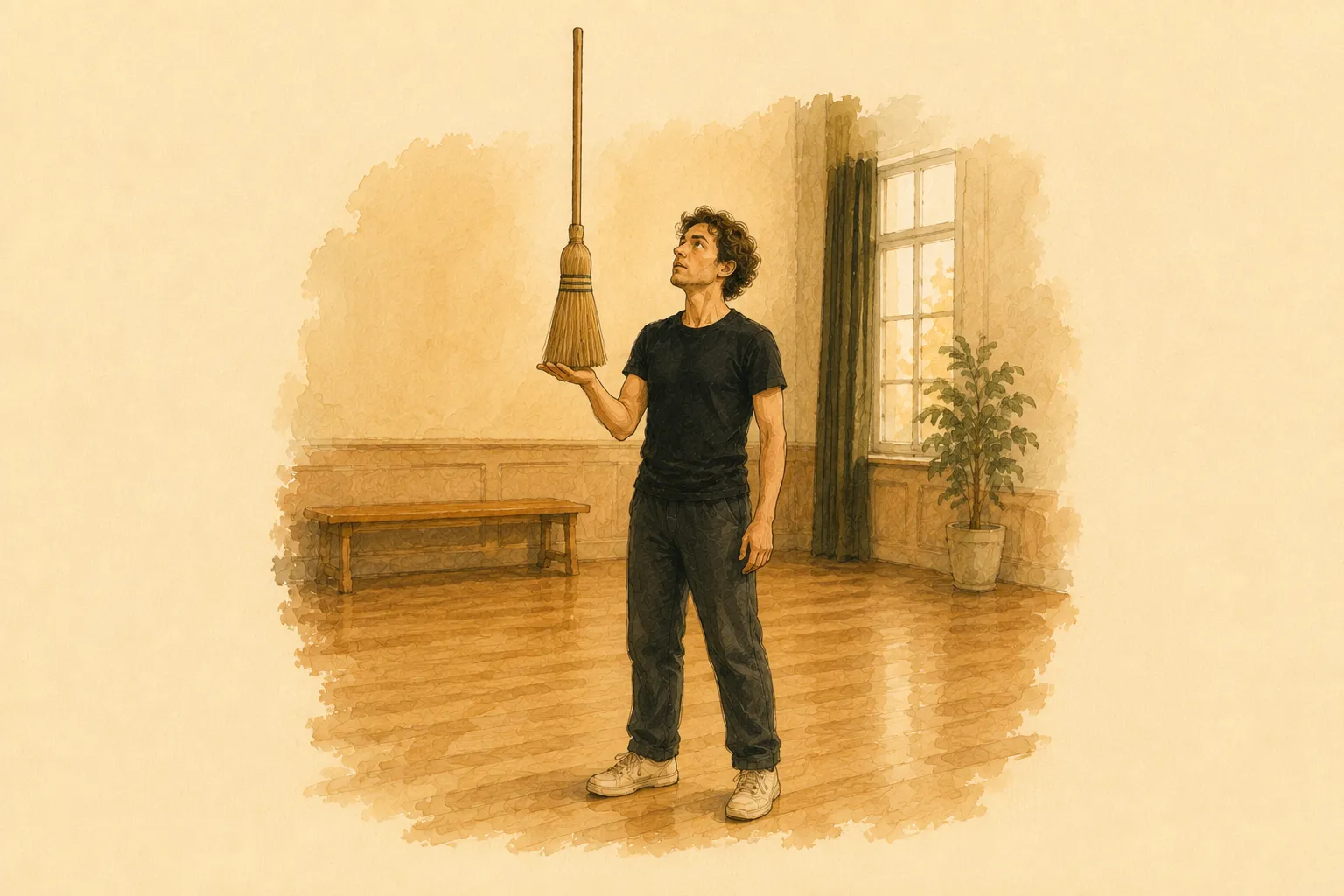
Viola Spolin’s argument, running through Improvisation for the Theater, is about attention. A student focused on a game acts naturally. A student focused on acting acts badly, and knows it, and gets worse. The point of concentration — one single objective the exercise is about — is what gets them out of their own way.
The idea is easy. Choosing the thing is not.
What makes a good one
It can be failed. “Keep the ball in the air” works because you can drop it. “Be present in the space” cannot be failed, so there is nothing to hold, and the student’s attention goes back to how they are doing.
It is outside the student. Something in the room, on the other person, in the object. The moment the point of concentration is internal — a feeling, a quality, a state — the student is watching themselves, which is the exact thing the technique exists to prevent.
It is one. This is the rule that gets broken most, usually with the best intentions. “Concentrate on the space object and keep the status difference” is two exercises, and a student doing two things is doing neither.
It survives being said in six words. If you cannot state it in a breath, it is a topic rather than a point of concentration.
Some that work
- Keep the temperature of the room in your body. Physical, external, failable.
- Get her to sit down. An objective, not a feeling. Almost always produces status work without anyone naming status.
- Never be the one who speaks first. Trains listening by making it structural.
- Make the object heavier than it was a minute ago. Space work that has a direction, which stops it becoming mime.
Some that do not
- Be truthful. A verdict, not a task.
- Have a strong character. Two abstractions in four words.
- Support your scene partner. True, important, and impossible to concentrate on. Turn it into something specific — “say her name three times” — and it becomes doable.
The urge to add a second one
You will watch a scene, see the point of concentration land, and see something else missing. The instinct is to add it. Resist it for one more round, because what you are watching is often the first thing working rather than the second thing missing — and a student who has just got hold of something loses it when a second demand arrives.
If the second thing genuinely matters, it is the next exercise. The sequence is the curriculum.
Where it goes if you write it down
A scored exercise makes this concrete: one point of concentration per beat, per person. That constraint is severe and it is the right one — a beat that carries two instructions is a beat somebody reads twice and acts on late.
It also exposes how much you were relying on being able to add a clarification mid-scene. Writing the beat first, in six words, is a good test of whether the exercise is actually one exercise.
Questions
- Can a point of concentration be an emotion?
- It works badly. 'Be angry' is a result, not something to concentrate on, and a student who tries produces a performance of anger. 'Get her to leave the room' can produce anger and is a thing you can actually hold.
- What if the class ignores it?
- That usually means it was not concentratable — too abstract, or too easy. Check whether it can fail. A point of concentration you cannot lose is not one.