
The first three lessons with a group that has never improvised
What to do before you ask anyone to make something up in front of their classmates, and why the order matters more than the exercises.
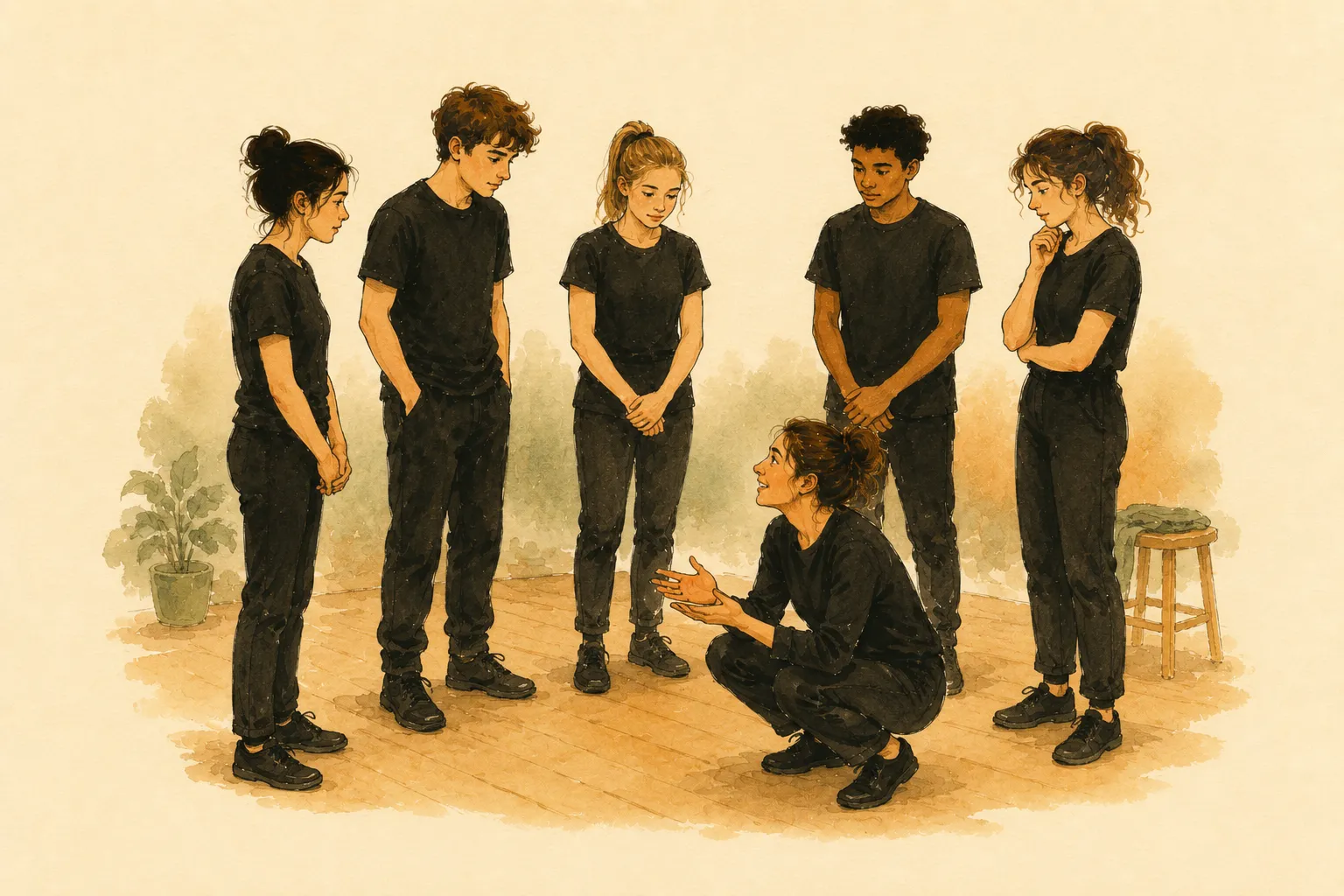
Most first improvisation lessons fail in the same way. The teacher, reasonably, wants to get to the work, so within twenty minutes two students are in front of the class making something up. It goes badly, everybody watches it go badly, and the group learns that this is what improvisation feels like.
The order below is designed to delay that moment for as long as possible.
Lesson one: nobody is watched
The goal is a room where everybody is doing something and nobody is being observed. Not a warm-up in the sense of getting the blood moving; a lesson in which the social cost of participating is as close to zero as you can make it.
Everything happens simultaneously. Whole-group walking exercises. Pairs working at the same time, all around the room, with no front. Mirroring in pairs, which is the most useful thing you can do in a first lesson because it requires attention on another person and produces nothing anybody can judge.
Nothing is shown. Resist entirely. A single “let’s see that one” in lesson one teaches the group that everything is potentially a performance, and you will spend the term undoing it.
If a student asks when they will do a scene, tell them lesson three. Knowing when it is coming is itself a kind of safety.
Lesson two: doing, in front of two people
The step is small on purpose: from nobody watching to two people watching.
Groups of four. Two work, two watch, then swap — inside the small group, without the rest of the class stopping. The room is still noisy, which matters, because a quiet room with one thing happening in it is a stage.
This is where the point of concentration arrives. Give one task, external and failable: keep the object the same weight, never speak first, get her to sit down. Not two tasks. Not a character. One thing to hold.
The two who are watching get a job as well, or they will become an audience by default. “Tell them one thing they did that you would steal” is enough, and it sets up the debrief vocabulary you want later.
Lesson three: the first scene, on your terms
Now, and with three constraints in place that most first scenes do not have.
It is short. Ninety seconds, timed, and you stop it. A scene that runs until it dies teaches the group that scenes die.
It has an ending built in. Tell them how it finishes before it starts — “it ends when he leaves”. Improvisers with twenty years of practice struggle with endings; a class in week three should not be asked to solve them.
It has a structure, not a premise. “You want something from her; she has already decided” is playable. “You are two astronauts” is a setting, and settings produce students demonstrating astronauts.
Run it several times with different pairs and the same structure. The repetition is the point — the group sees the same shape produce different scenes, which is the first genuinely improvisational thing that happens to them.
What the three lessons are actually building
Not skills. A group that has done this can barely do anything yet.
What it has is a working assumption that being watched is survivable, an experience of holding one thing rather than performing, and one scene that did not go badly. From there the technique is teachable. Without it every technique lands on somebody defending themselves, and the term goes to the students who were already confident.
The thing that undoes all of it
Laughter at somebody rather than at what happened. It is worth pre-empting in lesson one, in one sentence, without a speech attached: “we laugh at the situation, not at the person”. Say it once, then enforce it silently by not laughing yourself at the moment it would be easy to.
Students read what the teacher finds funny more accurately than anything the teacher says.
Questions
- How large a group is this written for?
- Twelve to twenty — a class rather than a workshop. Under ten, everything happens faster and you can skip most of the third lesson. Over twenty-four, split it; a scene with an audience of twenty-three is a performance, and performing is not what a first term is for.
- What if the group already knows each other well?
- That is not the same as being safe to be foolish in front of. A class that has been together for years has a settled social order, and improvisation asks people to risk their position in it. The first lesson still matters; the second may go faster.