
Endings: stopping a scene that will not stop
Most improvised scenes die rather than end. Where the ending actually lives, and four ways to give a class one without taking the scene away from them.
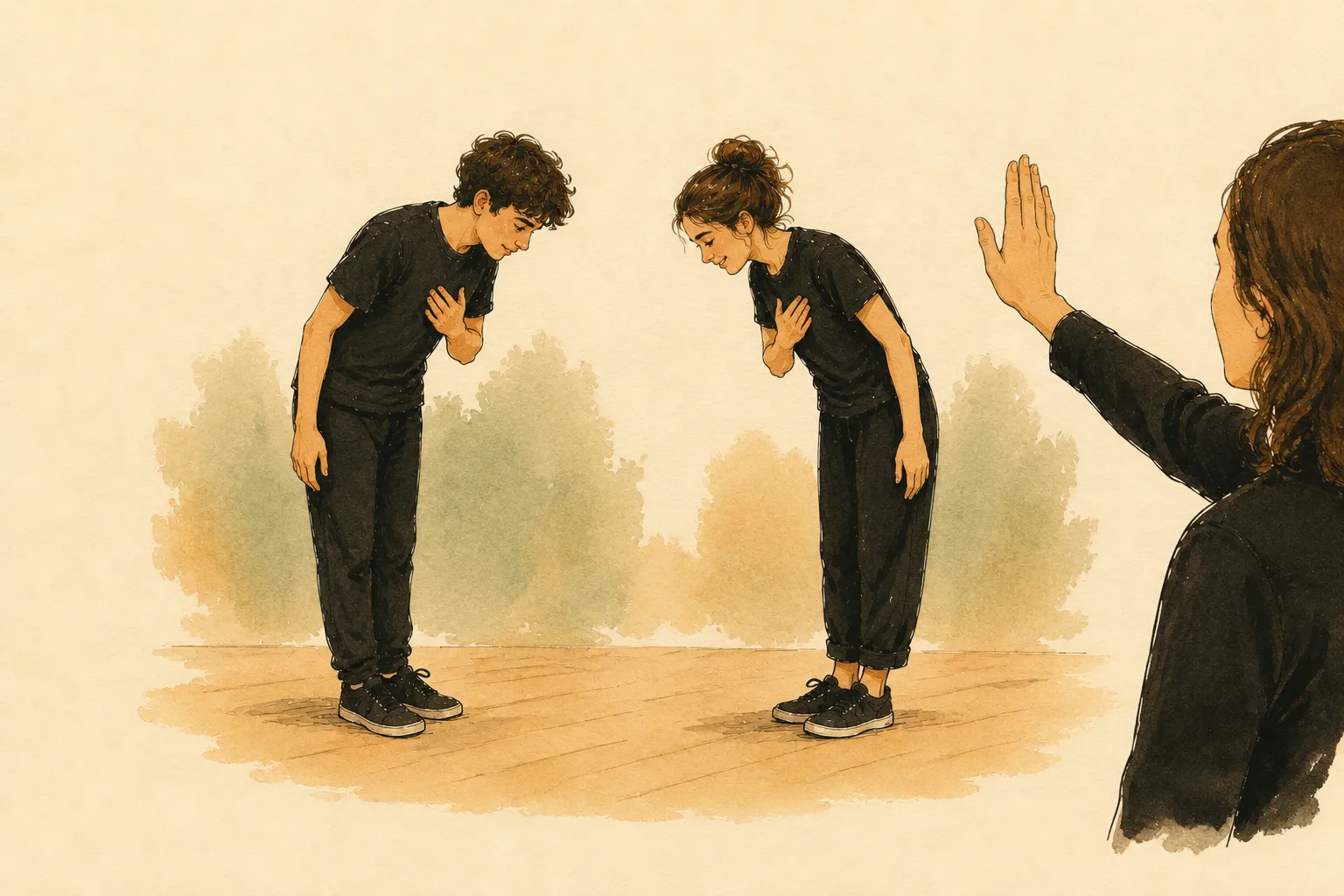
Watch any improvisation class for an hour and you will see the same shape repeatedly: a scene starts well, finds something, plays it, and then keeps going for ninety seconds after the interesting part is over. Eventually somebody says something conclusive, or the teacher says “and… thank you”, and everybody exhales.
The scene did not end. It stopped.
Why endings are the hardest thing
An ending requires knowing what the scene was about, and in improvisation nobody knows that until it has happened. Experienced improvisers end scenes by recognising a moment that could be the last one and choosing it — a skill that takes years, because it depends on a sense of shape that only builds from having seen hundreds.
Asking a class in week four to end their own scenes is asking them to solve the hardest problem in the form while also doing everything else. Predictably, they solve it the only way available: somebody makes a joke, or somebody dies.
Where the ending actually is
Usually about forty seconds before the scene stopped.
If you watch for it, you will see the moment: something changes, the thing the scene was about becomes visible, and then the students keep going because nothing told them not to. The material after that point is almost always worse than the material before it — they are elaborating a thing that was already complete.
Teaching students to see that moment is a long project. Ending the scene at it, for them, teaches them what it feels like, which is where the long project starts.
Four ways to give a class an ending
Time it and stop it. Ninety seconds, and you cut. Blunt, and it works immediately. The students stop trying to find an ending and spend the whole ninety seconds on the scene, which is where you wanted their attention. Some of the endings you cut into will be beautiful, and they will notice.
Build it into the structure. Tell them how it finishes before it starts: it ends when he leaves the room. Now the ending is a target rather than a search, and the scene has a shape everybody can feel. This is the version most worth using in a first term.
End on a beat count. If the exercise is scored, the score ends. A twelve-beat scene ends after the twelfth beat, and nobody has to decide anything. It is the most artificial option and the one that produces the most consistently complete scenes.
Cut on the change. The advanced version, and the one that teaches the most. You watch for the moment the scene becomes about something, let it land, and cut two lines later. Students feel the difference immediately and cannot articulate it — which is fine, because the point is to build the sense of shape before the vocabulary.
What not to do
Do not let it die. A scene that runs until everybody is uncomfortable teaches the group that scenes end in discomfort, and the next pair will play defensively. One cut is worth more than three notes.
Do not ask “how should that have ended?” in the debrief. It produces speculation about a scene that is over, from people who could not find the ending live. Ask instead: “where could it have ended?” — and take three answers. That is a question about shape, and it has several right answers.
Do not praise a clever ending too warmly. The class will spend the next lesson hunting for clever endings instead of playing scenes, and clever endings almost always mean somebody stopped listening in order to prepare one.
The exercise worth doing once a term
Run a scene. Cut it at ninety seconds. Then ask the two students to play the same scene again in thirty seconds, keeping only what mattered.
They will cut the beginning, which is what everybody cuts, and they will discover the scene was about the third thing that happened rather than the first. It is a lesson about shape that no amount of explaining produces, and it takes four minutes.
Questions
- Should the teacher end scenes, or should students?
- The teacher, for at least the first term. Endings are the hardest thing in the form and asking a beginner to find one adds a second impossible task to a scene they are already struggling to hold.
- How long should a class scene be?
- Shorter than you think. Ninety seconds produces better work than five minutes with almost any group below advanced, because the second half of a five-minute scene is usually two people looking for a way out.