
Side-coaching without stopping the scene
Spolin's most useful technique is also the hardest to deliver: a note to one player, mid-scene, that nobody else hears. What works in a room, and what does not.
Updated 3 October 2026
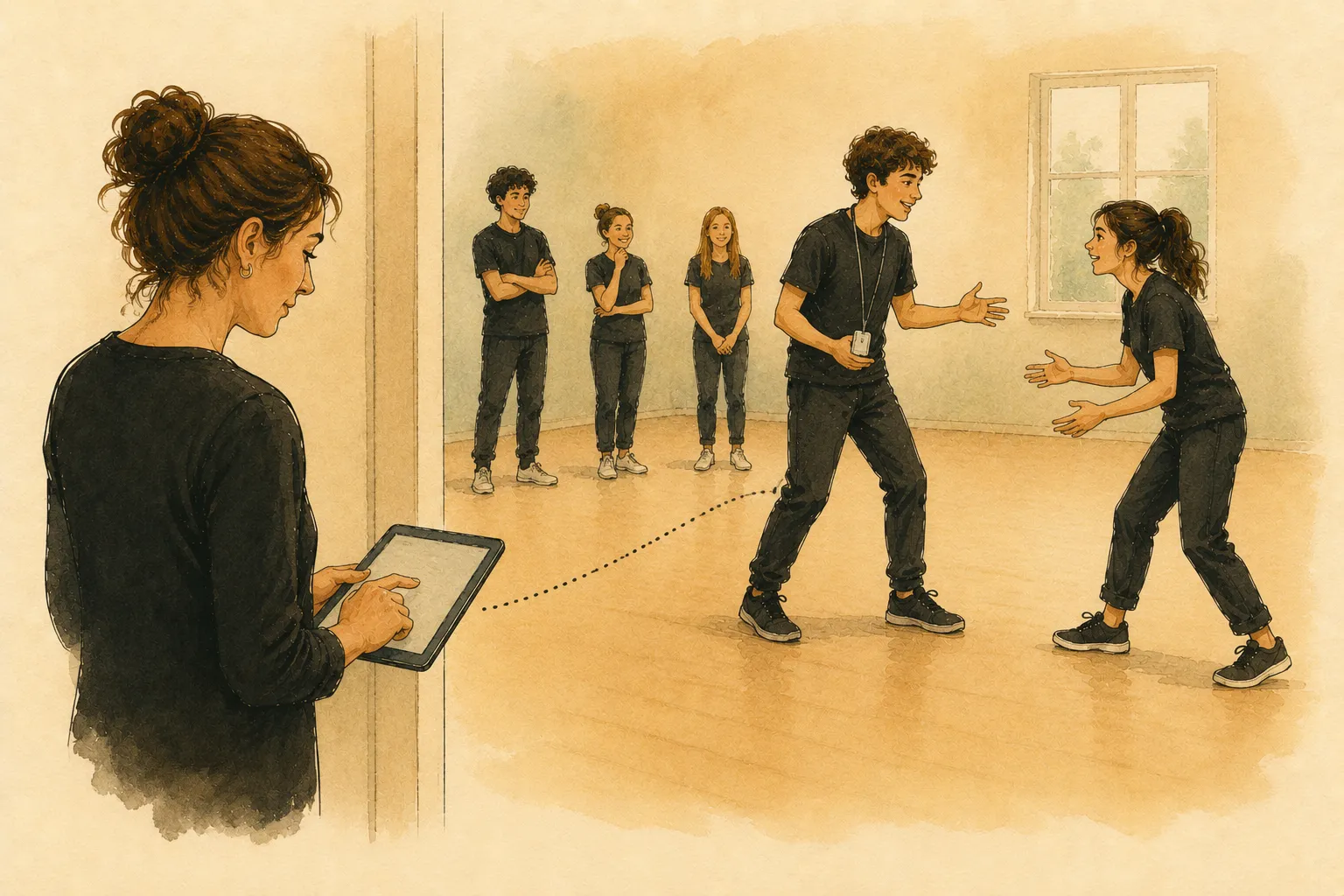
Viola Spolin called it side-coaching: a short instruction delivered while the scene is running, aimed at one player, meant to adjust something without breaking the fiction. Improvisation for the Theater is full of examples — “louder”, “slower”, “let her win this one”.
It is the single most useful thing a drama teacher does with an improvisation class, and it is the hardest to deliver well, for one banal reason: a room is full of people who can hear you.
What actually happens when you side-coach across a room
You say “slow down” to the player upstage left. Four things happen at once.
The player you addressed slows down, or freezes — the two are hard to tell apart from where you are standing. The other player, who was not addressed, also slows down, because they heard you and assumed the note was general. A third student, watching, learns that the teacher can interrupt, which changes what they will risk when it is their turn. And whoever was about to make an offer stops, because your voice is louder than theirs.
None of that is a failure of technique. It is what happens when a private instruction is delivered in public.
The workarounds, and why each one costs something
Whispering. Works, if you are already next to the player. Getting next to them means walking through the scene, which is its own interruption, and it means the other player watches you approach.
Stopping and restarting. Clean, and it kills the thing you were training. A scene that has been stopped and restarted is a different exercise: the students know what is coming, and the pressure that makes improvisation improvisation has gone.
Pre-loading the note. Telling everyone the point of concentration before the scene starts — Spolin’s own approach, and the right one for a class that has not worked together long. It cannot respond to what is actually happening in front of you, which is the whole reason you wanted to side-coach.
Writing it down for the debrief. The most common approach among teachers I have spoken to, and the one they are least satisfied with. By the debrief the moment has passed, and a note about a scene that finished four minutes ago is a note about a memory.
What the technique is for
It is worth being precise about the point, because the workarounds are only unsatisfying if you know what you are giving up.
Spolin’s argument is that a student focused on a game acts naturally, and a student focused on acting acts badly. The point of concentration — one thing to hold, not a character to build — is what gets them out of their own way. Side-coaching adjusts the point of concentration mid-scene, when the teacher can see it slipping.
That is a real-time correction to a student’s attention. It has to arrive while the attention is still there. Written down for later, it becomes feedback, which is useful and is not the same thing.
What a private channel would change
If a note could reach one player and nobody else, three of the four problems above would disappear. The other player would not adjust to a note that was not theirs. The watching students would not learn that the teacher interrupts. Nobody would stop.
What remains is the hardest part, and no technology touches it: knowing what to say, and when. A badly timed private note is still badly timed. A note that undermines what a student was reaching for still undermines it. The channel is a delivery mechanism; the judgement is the teaching.
This is worth saying plainly because it is where software about drama teaching usually oversells. A tool that hands an improviser a finished line has replaced the exercise. Spontar’s Live mode is the nearest thing to a private channel it offers: you type a prompt on the iPad and it reaches one player’s card and nobody else’s. It is its own way of running a scene — you cannot slip a note into a written scene that is already running — and typing is slower than three spoken words. The quick side-coach is still your voice in the room, which is why the two habits below matter with or without any tool.
Two things worth trying without any tool at all
Cut the note to three words. “Slower.” “Her, not him.” “Wait.” A long side-coach is an interruption whatever channel it arrives on, and the discipline of compressing it turns out to be most of the skill.
Coach the watcher, not the player. Some of the best side-coaching I have seen was addressed to a student who was about to enter, not one already in the scene. They can absorb it, they have time to act on it, and the scene does not wobble.
Neither needs anything but a room. If you take one thing from this, take the first one.
Questions
- Is side-coaching the same as stopping and giving a note?
- No. A note stops the scene and addresses the group; side-coaching happens while the scene continues and is usually addressed to one player. The distinction matters because stopping resets the students' attention, and the thing you are training — staying in a scene while adjusting — cannot be practised when the scene has stopped.
- How many players can you side-coach at once?
- One, reliably. Two if the room is small and both are downstage. Beyond that you are broadcasting, and a broadcast note is a note to the group, which is a different technique with different effects.