
Why students never see their own scores in Spontar
A feature we will not build, and the reasoning — which is about what improvisation trains, not about data protection.
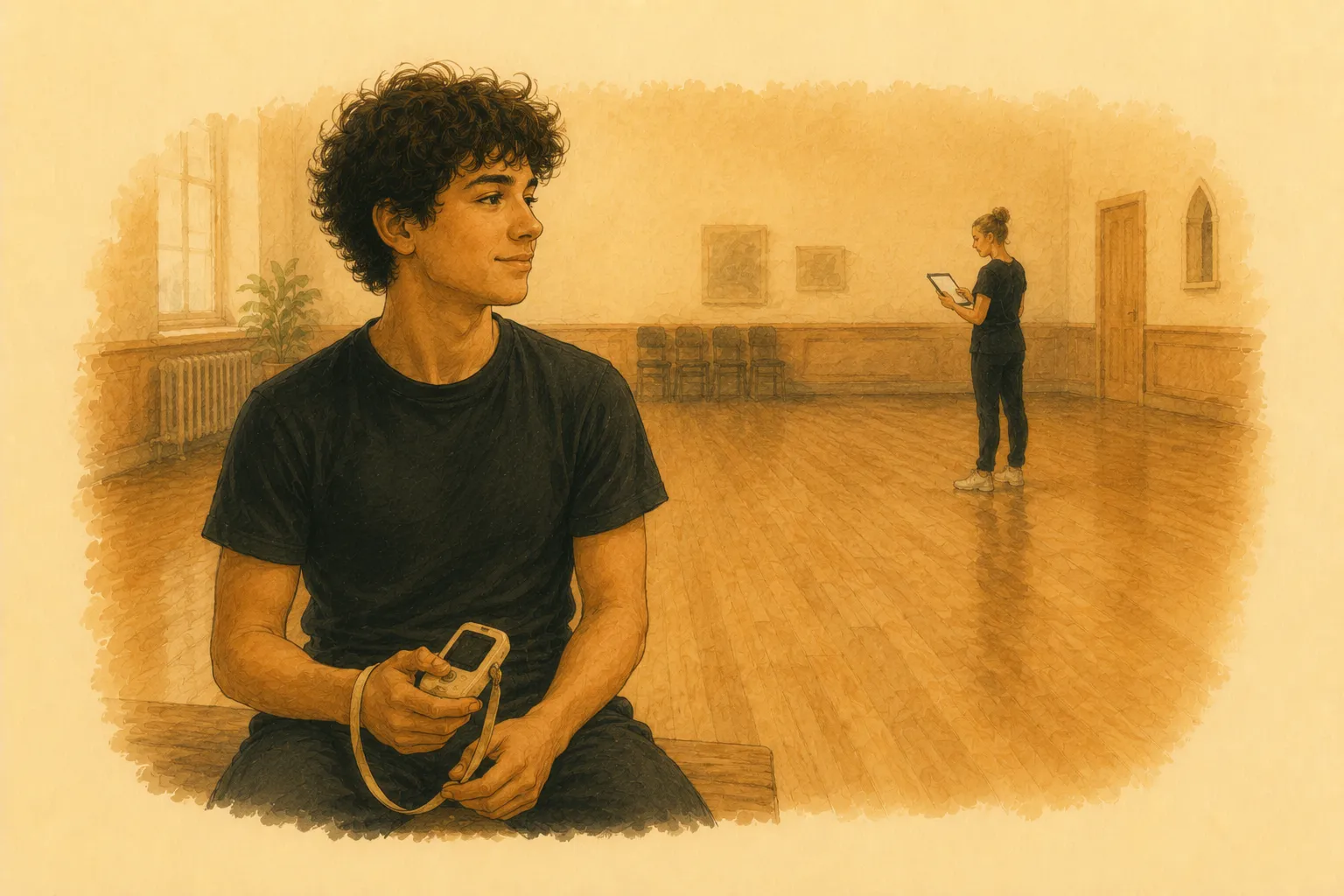
It is an obvious question about the product. A teacher can give optional scores and write a note on each lesson; every student has a card in their hand; the card could show each student how they are doing. It seems obviously useful.
We will not build it, and the reason is not data protection. It is what improvisation is for.
The mechanism it would break
Spolin’s argument, which the whole design rests on, is about where attention goes. A student focused on a game acts naturally. A student focused on how they are doing acts badly, knows it, and gets worse. The point of concentration exists to move attention outward — onto the other person, the object, the room.
A score on a student’s screen moves it back. Not because the number is discouraging — an encouraging number does it just as effectively — but because it makes the student the subject of their own attention at the exact moment the exercise needs them not to be.
There is no version of this that is safe. A running average, a streak, a green tick after a good beat: each of them answers the question how am I doing, and that question is the one the technique exists to suppress.
What would actually happen
Predictably, and quickly.
Students would play for the indicator. Not consciously; they would simply gravitate toward the choices that produced the green thing, and the choices that produce a green thing are the safe ones. Improvisation rewards risk that frequently fails, and any visible measure selects against exactly that.
The quiet student would find out they are behind. They already suspect it. A number confirms it, and confirmation is not information they can act on mid-scene.
And the teacher’s notes would change. A note that a student will see is a note written for the student, which means it becomes gentler, vaguer, and less useful — and the teacher loses the only record that was helping them cast next week.
What the notes are for
They exist so the teacher can plan. Who works well opposite whom. Who has not been seen in two lessons. Whether the constraint landed. That is the whole purpose, and none of it requires the student to see anything.
They are visible to the teaching teacher and to nobody else — not the head of department, not the institution’s owner, not us in ordinary operation. They are deleted after a year by default, because a note about a fifteen-year-old is not something anybody needs when they are eighteen.
The institution’s owner sees usage figures: how many sessions, which scenarios, how long. Those contain no student at all — no name, no identifier, no per-student row. The two records are never joined, which is what allows an owner to see whether the product is being used without seeing how a child performed.
The feature that would be worse than useless
A student-facing summary at the end of term. It sounds harmless, and it is the same mechanism arriving later: a student who knows a summary is coming plays for the summary all term.
There is a version of this we might be wrong about — a purely descriptive record with no evaluation in it, “you played eleven scenes and held the constraint in nine”. If a teacher can make a case that it helps a student rather than watching them, we would listen. We have not heard one yet, and the burden is on the feature.
What we will build instead
Better notes for the teacher. Faster to write, easier to search, more useful in the moment somebody is deciding who to put opposite whom.
That is where the value is, and it does not require a student to ever know the notes exist.
Questions
- Can a teacher share a note with a student verbally?
- Of course, and they should. What the product does not do is put a running record in front of a student's face. A teacher deciding to tell somebody something is a teaching decision; a dashboard telling them continuously is not.
- What about students who ask?
- Tell them what you observed. That is a better conversation than a number, and it is the one the notes were written to support.