
The Joker position: intervening without entering
Boal invented a role that is neither performer nor audience. It is also the most accurate description of what a drama teacher does during an exercise.
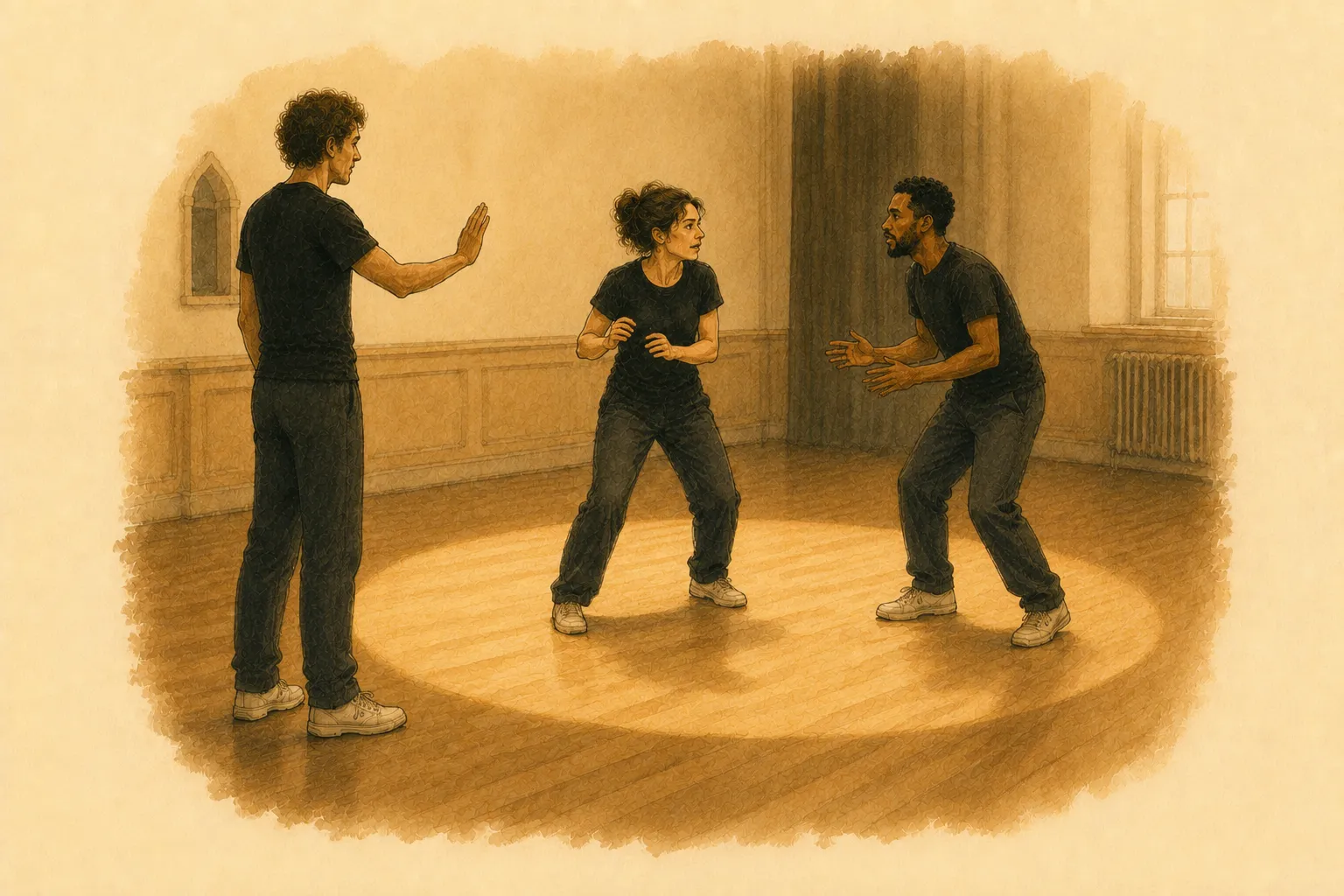
Augusto Boal’s Theatre of the Oppressed introduced a figure with an awkward name and a precise function. The Joker — curinga — is neither in the scene nor watching it. They interrupt, they question, they hand decisions to the room, and they never resolve anything.
Boal built the role for Forum Theatre, where an audience member replaces a protagonist and tries a different tactic. But the position is portable, and it describes something drama teachers do constantly without having a word for it.
What the position actually constrains
The Joker’s power comes from what they are forbidden to do.
They may not resolve the scene. A Joker who says “so what she should have done is…” has taken the exercise away from the room. The question goes back out; the answer is somebody else’s.
They may not tell the audience what it saw. Boal is explicit and slightly severe about this. The Joker asks “what happened?” and lets an incorrect answer stand long enough for somebody else to disagree with it.
They are visible. Not a director in the dark. The room knows there is a person whose job is to interrupt, which is what makes the interruption a normal event rather than a correction.
Those three constraints are why the position works, and all three are easy to lose in a classroom, where the person holding it also happens to be the person who assesses.
Why it is harder for a teacher than for a Joker
Boal’s Joker has no grades to give. Yours does. A student who is asked “what happened in that scene?” by the person who marks their coursework is answering a different question from the one you asked, and both of you know it.
Two things help, and neither is a trick.
Ask about the scene, not the student. “What changed between them?” is answerable. “What did she do well?” is a request for a verdict from people who have learned that verdicts are yours to give.
Let a wrong answer sit. Ten seconds is enough. The room will correct it, and the moment it does, the room has taken a position — which is the thing you were trying to produce, and which cannot happen if you correct first.
Intervening without entering
The other half of the Joker position is the mid-scene interruption, which is a different problem from the debrief and the harder one.
Boal’s Joker stops the action to ask the audience something. In a class, the equivalent is stopping to redirect attention — and the cost is what Spolin identified about side-coaching: the interruption reaches everybody, and it resets the exercise for the people who were not the point of it.
The workarounds are the familiar ones. Move next to the player. Pre-load the constraint. Let it go and take it to the debrief. Each costs something, and the choice between them is most of the craft.
What is worth naming is that the Joker position makes the cost visible. A teacher who thinks of themselves as directing does not notice interrupting; a teacher who thinks of themselves as jokering notices every time, because the role is defined by what it does not do.
One exercise worth stealing wholesale
Run a two-minute scene. Stop it at the point of difficulty — not the end, the difficulty. Ask the room a single question with more than one right answer: “what does she want that she is not saying?”
Take three answers. Do not adjudicate. Then run the scene again with a different person in the role, and let the room see what the answers were worth.
That is Forum Theatre with the politics taken out, and it works on a Tuesday with fifteen-year-olds who have never heard of Boal.
Questions
- Does using the Joker position require doing Forum Theatre?
- No. Boal developed it inside Forum Theatre and the position is portable. What transfers is the stance: present, addressing the room, and structurally outside the fiction — which is what lets an intervention land without breaking it.
- Is the Joker the same as a facilitator?
- Facilitator is a job description. The Joker is a position in the room with rules about what it can and cannot do — it may not resolve the scene, and it may not tell the audience what to think. Those constraints are the whole value.