
Mixed-age groups: what changes
A thirteen-year-old and a seventeen-year-old in the same scene are not doing the same exercise. What actually differs, and how to cast around it.
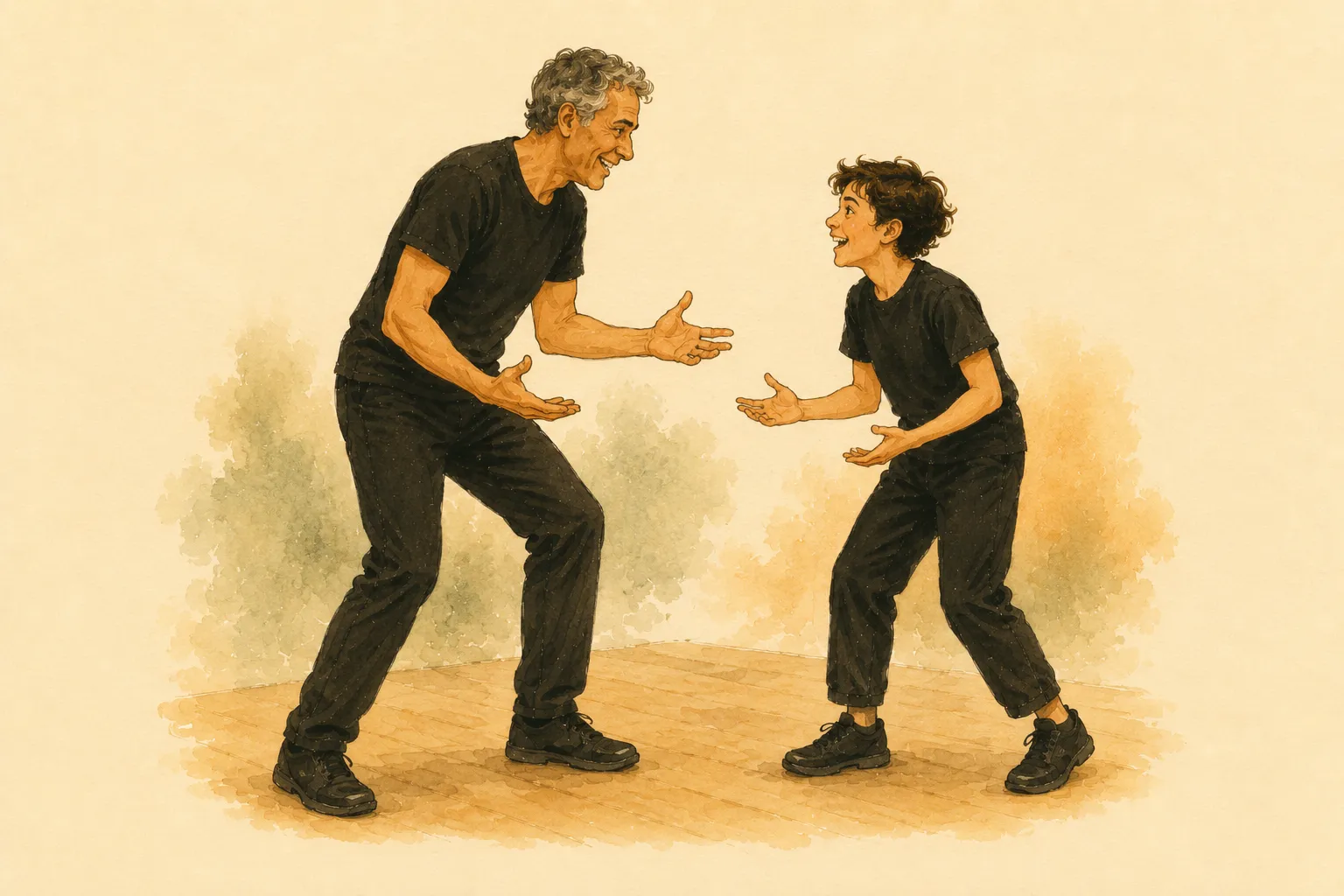
Studios run mixed groups because that is who signs up. Schools run them in after-school clubs and in small-cohort electives. The received wisdom is that it works fine, and it does — but not as a single class doing a single exercise, and the ways it fails are specific enough to plan around.
What actually differs
Not skill. A confident thirteen-year-old will often outplay a self-conscious sixteen-year-old, and the assumption that older means better is wrong often enough to be worth abandoning.
Social exposure. This is the real difference. A thirteen-year-old and a seventeen-year-old are risking different amounts by looking foolish in front of each other, and they are risking it in different directions. The younger one is being watched by someone whose approval matters enormously; the older one is being watched by someone they are supposed to be ahead of.
Content tolerance. Not the same as maturity. A seventeen-year-old can play a scene about a break-up; a thirteen-year-old can too, and the scene means something entirely different when they are opposite each other.
Attention span for abstraction. “Play the status difference” lands with a sixteen-year-old and slides off a twelve-year-old, who needs the same instruction as an objective: get her to move.
How to cast
Pair across, not within. The instinct is to group by age, and it produces two classes in one room and a resentful older half. Pairing a fourteen-year-old with a seventeen-year-old works better than either homogeneous pairing, provided the task is chosen for the younger one.
Give the older student a structural job. Not “look after him” — that is a social instruction that turns into condescension. A structural one: you have already decided; he has not. The older student now has something to do that happens to make the scene work, and neither of them has been told the reason.
Never make the age difference the scene. A scene where a seventeen-year-old plays a parent and a thirteen-year-old plays a child imports the real hierarchy into the fiction, and the fiction stops being a place to try things.
What to write for
Always the youngest person in the room. A scenario that is fine for the older half and merely uncomfortable for the younger is not a compromise — it is a scenario that has excluded somebody who will not say so.
The practical rule that covers most of it:
No romance. No violence. No humiliation. Nothing that asks somebody to perform distress.
That constraint sounds limiting and is not. Almost every good improvisation exercise — status, offers, objectives, space work, listening — passes it without modification, because none of them ever needed those things.
The thing that makes mixed groups work
The older students end up teaching, and teaching is the fastest way to understand something.
That happens on its own if you let it, and it stops immediately if you name it. A seventeen-year-old told to “help the younger ones” becomes a supervisor; a seventeen-year-old given a structural role in a scene with a fourteen-year-old teaches by doing, and both of them think they are just doing the exercise.
When to split
When the same exercise stops working for both halves in the same lesson — usually around the point where the older students are ready for scenes with sustained emotional content and the younger ones are not.
Splitting for ten minutes inside a lesson is easier than splitting the group, and it lets the two halves come back together for the debrief, which is where the mixed group earns its keep.
Questions
- Is a mixed group worth running at all?
- Often yes, in a studio where the alternative is not running. The older students improve faster than they would in a peer group because they end up teaching, and the younger ones get a model that is not the teacher. What it is not is a single class with a single exercise.
- What about content?
- Write for the youngest person in the room, always. A scenario that is fine for seventeen-year-olds and merely uncomfortable for a thirteen-year-old has cost you the thirteen-year-old, and they will not tell you why.