
The student who will not go on
Refusal in a drama room is usually about being watched, not about the exercise. Four things that help, and two that make it permanent.
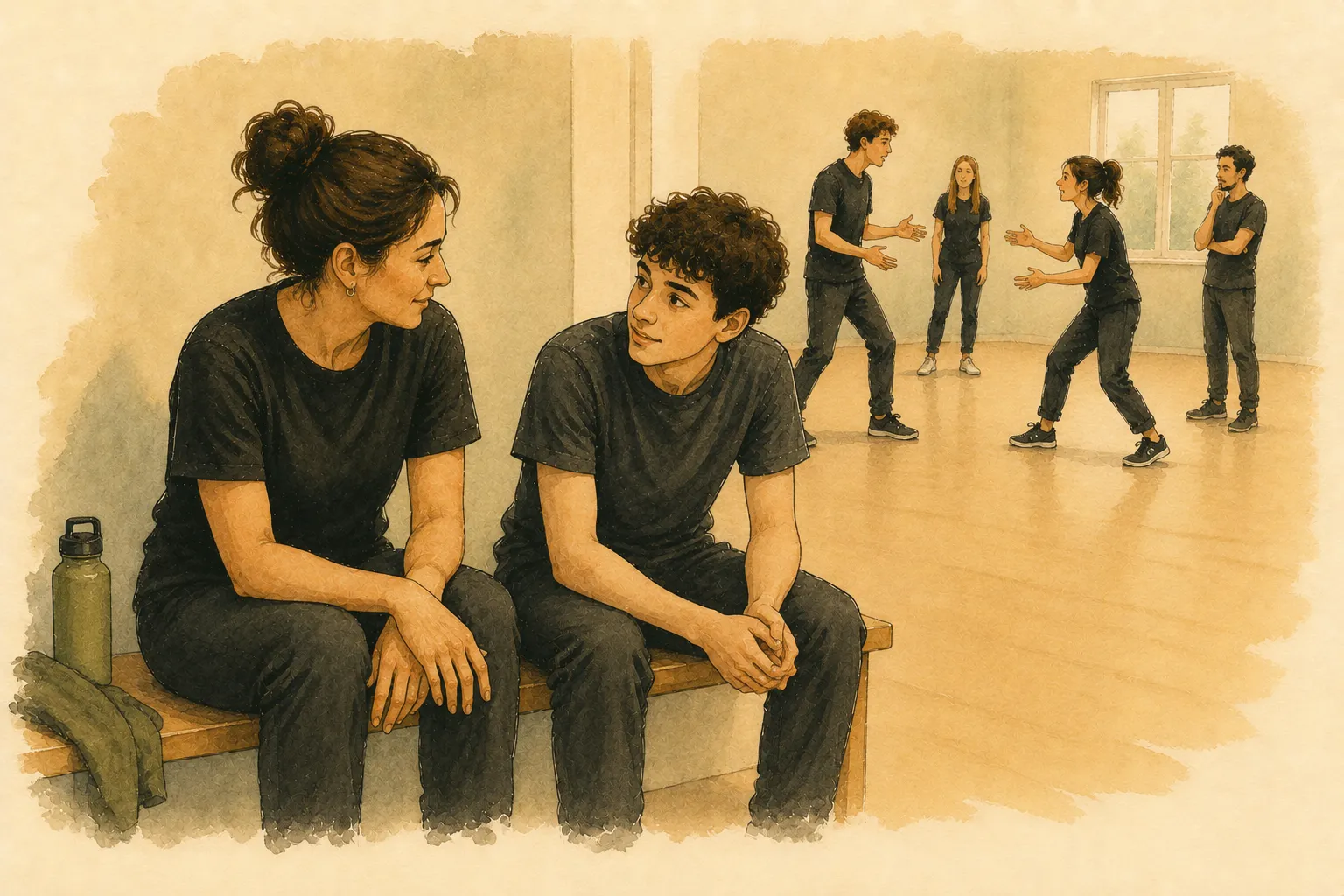
There is one in most classes. They will do the warm-up, they will work in a pair, and when the exercise turns into something with an audience they find a reason: they are ill, they will go next time, they would rather watch.
The mistake is treating it as a discipline problem, or as a confidence problem to be talked through. It is usually a much more specific fear, and specific fears respond to specific changes.
What they are usually afraid of
Not performing. Being seen failing at improvising in front of people whose opinion matters — which is a different thing, and it is entirely rational. In an improvisation exercise the failure is public, immediate, and looks like a personal deficiency rather than a technical one.
A student who has watched someone else dry up and heard the room go quiet has correctly worked out that the risk is real.
Four things that help
Shrink the audience before you shrink the task. Working in fours, with two watching, is not a smaller version of performing to the class — it is a different activity with a different social risk. Most students who will not perform to twenty will work in front of three, and that is not a compromise, it is the right size for learning anything.
Give them a job in the scene that is not being interesting. Operating a door. Holding an object. Being the person who has already decided. A task with a correct execution gives them somewhere to put their attention that is not the audience, which is Spolin’s whole argument applied to one student.
Let them go second. Never first, and not last either — last is worse, because they watch everybody and the anticipation compounds. Second or third, after the shape is established and before it becomes a standard to meet.
Cast them with somebody generous. Not their friend, necessarily. Somebody who will take an offer and make it work, so that whatever they do turns out to have been fine.
Two things that make it permanent
Making it a public negotiation. “Come on, everyone else has” in front of the room converts a private fear into a public position, and a public position has to be defended. After that, going on means backing down, and the student now has two reasons not to.
Waiting for them to be ready. The most humane-sounding and the least effective. A student who is waiting to feel ready will wait all year, because the feeling arrives after the doing rather than before it. The version that works is a smaller thing they can do today, not the same thing later.
A sentence that works better than most
Said quietly, to one student, not as an announcement:
“You can do this one sitting down, and you only have to say three words.”
It removes the two things they are actually afraid of — standing up in front of people, and having to be inventive — and leaves an activity they can complete. The next one can be four words.
When it is not about being watched
Sometimes it is not. A student who will not do a scene about a family argument may have a family argument at home; a student who will not be touched has a reason. You will not always be told, and you do not need to be.
The general rule is that the exercise should be changeable without an explanation being required. If a student can opt out of a specific scenario without opting out of the subject, most of these situations resolve themselves quietly, which is how the student would prefer it.
Questions
- Should participation be part of the grade?
- Where you have a choice, no. A student who is anxious about being watched and is also being marked on being watched has two problems, and the second one makes the first worse. Where a specification requires it, be explicit about what is being assessed — usually the work, not the willingness — and say so out loud.
- How long should you leave it?
- A term is not too long for a student who is genuinely frightened, provided they are doing everything else. What is too long is a term in which nobody has offered them a smaller version of the thing.