
Recording without ranking
Notes that help you next Tuesday look nothing like notes that produce a grade. What to write down during a session, and what to leave out.
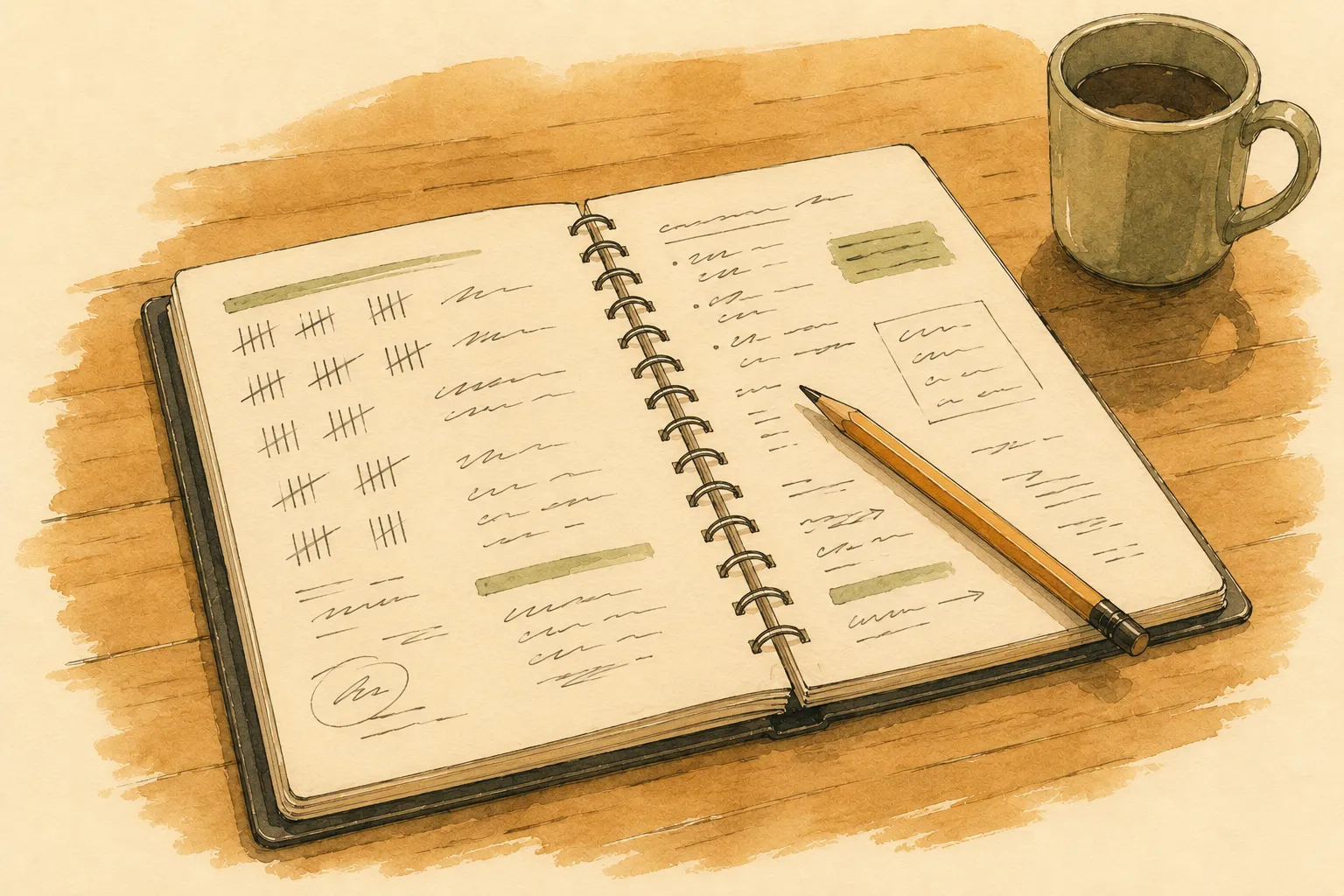
There are two kinds of writing a teacher does about a class, and they are almost opposites.
One produces a grade. It is comparative, defensible, tied to criteria, and written to be read by somebody who was not in the room. The other helps you plan Tuesday. It is specific, provisional, often unflattering, and useless to anybody else.
Most note-taking systems fail because they try to be both.
What planning notes are actually for
Three decisions, and they recur every week:
Who to put together. The single most consequential thing a drama teacher does with an improvisation class, and the one most often decided by proximity. A note that says works well opposite Yusuf, freezes opposite Lina is worth more than any assessment of either student.
What the group can hold. Whether a constraint landed, whether the scenes were too long, whether the exercise was two exercises. This is a note about the lesson, not about the class, and it is the one most likely to be lost.
Who to watch next time. Not who was good. Who you did not see — the quiet pair at the back that you never got to, twice running.
The form that survives a session
Three words, during or immediately after, per student per scene. It has to be writable without looking away from the room, or it will not be written.
- took the offer
- froze on entry
- held it, lost it at the end
- adjusted on her
- not seen — again
That last one is the most valuable note in the set and the one nobody writes.
Anything longer will be reconstructed later, and a reconstruction is a record of who you remember, which correlates with who was loud.
What to leave out
Anything about personality. “Shy”, “attention-seeking”, “difficult” — these describe a person rather than a lesson, they follow the student around, and they are read by whoever inherits the class next year as a settled fact.
Anything comparative. “Better than most of the group” is a ranking, and a ranking in a planning note has no purpose except to become one.
Anything you would not say to the student. Not because they will read it — they should not — but because the test is a good one. A note that fails it is usually a note about your frustration rather than about the work.
Why students should not see their own
This is worth stating plainly, because it runs against the instinct that transparency is always better.
A student who knows they are being noted performs for the note. In improvisation that is fatal: the whole exercise depends on attention being on the other person, and a student who is being watched-and-recorded puts their attention on themselves, which is the exact failure Spolin’s technique exists to prevent.
There is a second reason, less often said. A note about a student’s difficulty is a note about a difficulty they may not have named to themselves. “Freezes on entry” is an observation to you and a diagnosis to them, and a fifteen-year-old does not need a diagnosis from a person who saw them for forty minutes.
What to do with them at the end of the year
Delete the individual ones. Keep the ones about exercises.
The first are about students who have changed. The second are the only thing that makes next year’s first term better than this year’s, and they are the notes nobody thinks to save.
Questions
- Should students see these notes?
- The ones about the exercise, yes — 'this group needs shorter scenes' is useful to everybody. The ones about individuals, no. A note written to help you cast next week reads very differently to the person it is about, and it was not written for them.
- How long should you keep them?
- Long enough to plan the next term and no longer. A note about a fifteen-year-old's confidence is not something anybody needs three years later, and keeping it invites somebody to read it who was not there.