
Blocking is information
A student who refuses an offer is telling you something about the exercise, not about themselves. What the refusal usually means, and what to change.
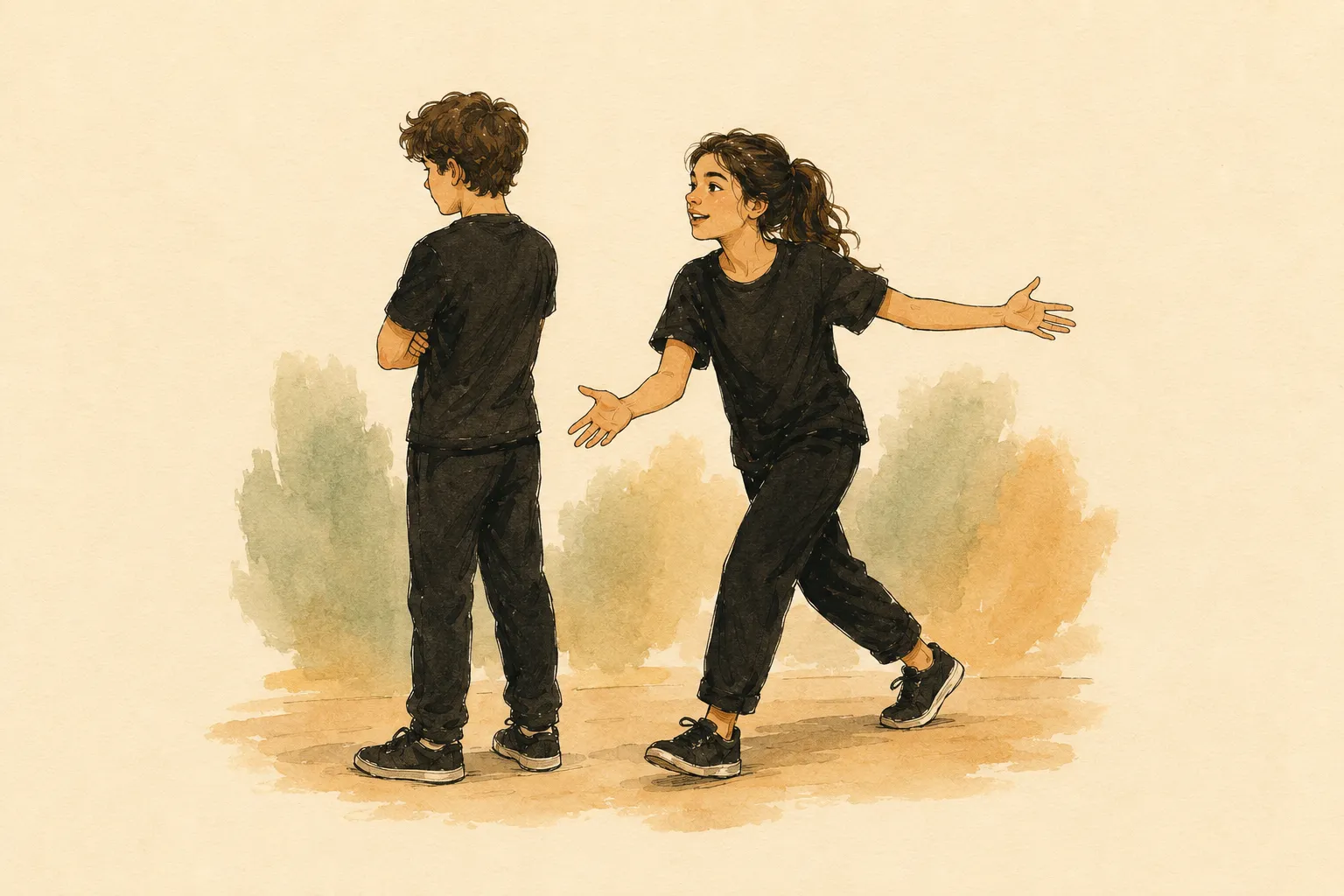
Every improvisation teacher has a version of the same note: don’t block. It is in every handbook, and it is right about the form and wrong about the room.
A student blocks because accepting was harder than refusing. That is a fact about the exercise you set, and it is much more useful than a fact about the student.
What a block usually means
“I do not know what to do with that.” The most common one, especially in a first term. The offer was too specific, or it arrived too fast, and the student took the only exit available. Blocking is the improvisational equivalent of saying “sorry, what?” — except it looks like refusal, so it gets treated as one.
“I do not want to be that in front of these people.” The offer landed somewhere social. Somebody has been made a parent, a boyfriend, a person with a body, and the room has an opinion about it. Refusing is cheaper than being seen accepting.
“This is the funny move.” A block gets a laugh, reliably, because it breaks a frame. If the group laughs, the group has just taught the student something, and it was not what you wanted.
“I have a better idea.” The most fixable one and the one that reads as the rudest. A student who blocks to install their own premise is not disengaged; they are engaged and impatient.
What to change, per case
For “I do not know what to do with that” — reduce the specificity of the offers. An offer of “you’re my sister” is harder to take than “you’ve been here a while”. Concrete-but-open is the shape you want; concrete-and-closed is what produces blocks.
For “not in front of these people” — this is a group-safety problem and no note will fix it. Change who is watching. Two scenes running in parallel halves the audience and roughly halves the blocking, which is a bigger effect than any instruction I have seen.
For the laugh — remove the payoff. A constraint that makes the joke unavailable does more in one scene than a term of asking. Silent scenes are the blunt instrument; a fixed objective is the sharper one, because the student still has something to do.
For “I have a better idea” — give them the first offer. Genuinely, as an assignment: they open, everybody else accepts. Some students need to have been right once before they can let somebody else be.
The rule that works better than “don’t block”
“Whatever the last person said is true.”
It is the same instruction, aimed at the world instead of at the behaviour. A student can hear “don’t block” as a criticism of their instinct; “that’s true now” is a fact about the fiction and nobody’s fault. In a group that is struggling, the second one moves faster.
What not to do about it
Do not stop the scene to name it. A blocked offer that gets a public note becomes a moment about the student who blocked, and the next person to receive a difficult offer will remember it. Note it, keep the scene, and change the exercise next time.
Do not make acceptance an assessment criterion. A student who is being assessed on accepting will accept — visibly, performatively, and without meaning it. The habit you want is invisible when it is working, which is exactly why it does not survive being graded.
Questions
- Is 'never block' a good rule to teach?
- As a rule it produces students who accept everything and mean none of it. As a habit it is the foundation of the form. Teach the habit by building exercises where accepting is the easy path, and the rule stops being necessary.
- What about a student who blocks to be funny?
- Usually the group is rewarding it, and the group is the thing to change. A constraint that makes the laugh unavailable — no dialogue, or a fixed objective — removes the incentive faster than a note does.